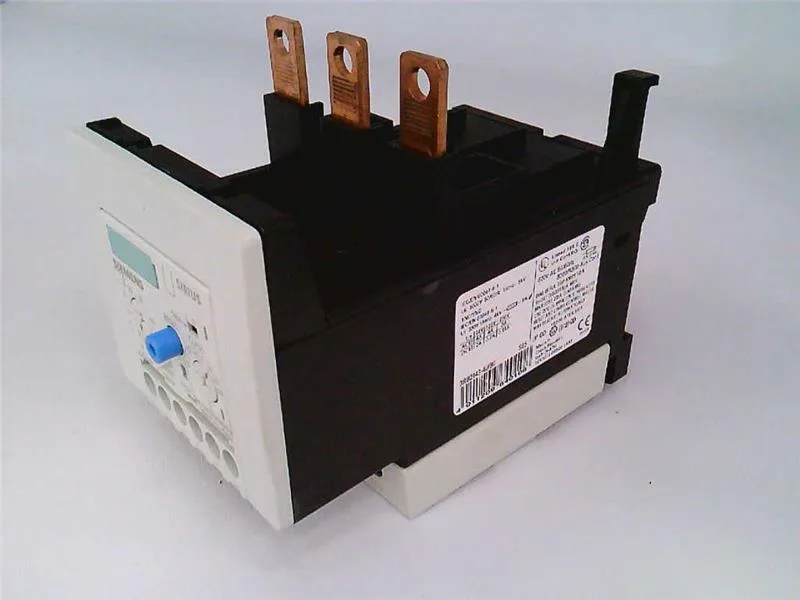
The Siemens 3RB2143-4UB0 is a SIRIUS solid-state overload relay — a 3-pole device that protects motor circuits against overload and phase failure without the mechanical wear of a bimetallic strip. It mounts directly onto a contactor (contactor mounting, per the spec), so the whole motor starter package stays compact on the DIN rail. The trip class is adjustable across four settings — CLASS 5E, 10E, 20E and 30E — which means you can tailor the tripping time to the starting characteristic of the load: fast for a pump that starts unloaded, slower for a high-inertia fan or conveyor.
The auxiliary contact ratings cover a wide control-voltage range: 2 A at 24 V, 4 A at 120 V, 3 A at 230 V, and 0.55 A at 60 V, among others. That means the same relay works in a 24 VDC PLC-controlled cabinet or a 230 VAC relay-logic panel without swapping out the aux block. The main-circuit terminals accept solid wire from 0.5 to 4 mm² (or 2x 0.5 to 2.5 mm²) and stranded up to 70 mm² — sized for motor feeders up to roughly the 50-60 A range, depending on the contactor frame. It handles 100 % relative humidity during operation — no derating needed for condensing environments inside a non-heated enclosure. Shock resistance is rated at 15g / 11 ms, which covers most industrial vibration profiles without needing a separate shock mount.
The relay fastens directly to the contactor (contactor mounting), saving a DIN-rail slot. Dimensions: 70 mm wide, 106 mm tall, 124 mm deep. Clearances: 0 mm upwards, forwards, and backwards; 6 mm at the side. That tight clearance means you can pack starters side-by-side without extra spacing, as long as the side gap is respected. The ATEX approval (PTB 06 ATEX 3001 Ex II (2) GD) allows installation in Zone 2 gas and Zone 22 dust atmospheres — relevant for chemical or grain-handling lines where a standard overload would be a non-starter.