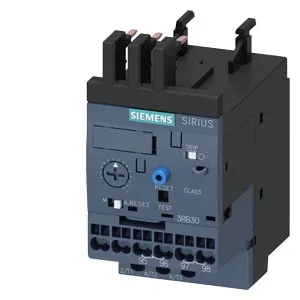
What the CLASS 20E rating means for motor protection
The 3RB3016-2SE0: The CLASS 20E trip class means this relay allows a 12 A thermal current motor to start under heavy inertia loads — it will not trip on a normal start that lasts up to 20 seconds at 600% locked-rotor current. That is the standard for most conveyor, pump, and compressor drives in industrial panels. The electronic overload release (not a bimetal strip) gives repeatable trip curves without ambient-temperature drift, and the temperature compensation is active across the full -25 to +60 °C operating range.
Panel fit and mounting — size S00 with spring-loaded terminals
Size S00 means this relay is designed for direct contactor mounting — it snaps onto the matching SIRIUS contactor without extra DIN-rail space. The 45 mm width and 72 mm height keep the assembly compact in a crowded panel. Spring-loaded terminals accept 2x (0.25 to 1.5 mm²) solid or stranded wire — no screw torque to check, just push in the ferrule. The screwdriver shaft diameter 5 to 6 mm and Pozidriv PZ 2 tip are only needed for the auxiliary contact terminals.
Auxiliary contact switching capacity — what the voltage-dependent ratings tell you
The integrated auxiliary switch (signaling contact 95/96 for 'not tripped', 97/98 for 'tripped') is rated 2 A at 24 V, 4 A at 120 V, and 3 A at 230 V — these are the make/break capacities for the fault signal loop. At 24 VDC the 2 A rating is the limiting case; at 60 VDC it drops to 0.55 A, so confirm the PLC input draw if running a long DC loop. The note 'for message tripped' on the auxiliary contact means the 97/98 contact only closes when the relay has actually tripped — it does not indicate a powered state or a test condition.