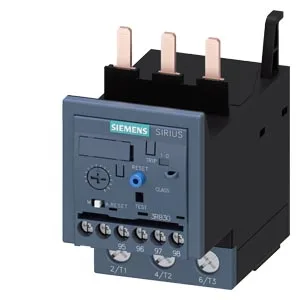
The Siemens 3RB3036-2UB0 is a SIRIUS solid-state overload relay. It's a Size S2 unit with a CLASS 20E trip curve — meaning it lets a motor draw locked-rotor current for up to 20 seconds before tripping. That's the standard protection for standard-start induction motors driving pumps, fans, or conveyors where the load doesn't need a fast trip on stall. Rated thermal current is 50 A continuous, and it's rated for use on systems up to 690 V. At 480 V and 600 V, the full 50 A rating holds. That covers a solid range of North American and IEC motor full-load currents up to about 25 kW on a 400 V line. The integrated auxiliary contact is wired as a normally-closed 'tripped' signal. The note says 'for message tripped' — that's the contact that opens when the relay trips, giving your PLC or annunciator a clean status. It's rated 4 A at 120 V and 3 A at 230 V, so it'll drive a small relay or input directly.
Mounts directly onto the contactor — no DIN rail needed. The fastening method is 'contactor mounting', so it clips onto the front of a matching SIRIUS contactor. That saves a DIN-rail slot and keeps the power wiring short. Main circuit terminals are M6 screw-type, accepting 1x 50 mm² stranded or 2x (10 to 35 mm²) stranded. That's heavy wire for a 50 A device — lets you land the motor leads without adapters. Control terminals take 0.5 to 4 mm² solid or 0.5 to 2.5 mm² stranded. Use a PZ2 Pozidriv screwdriver with a 5 to 6 mm shaft diameter. Dimensions are 55 mm wide, 99 mm high, 104 mm deep. That's a compact footprint for a 50 A relay — fits easily in a shallow enclosure.
Environmental toughness
Rated for the grease and grit of a real motor control center. Shock resistance is 15g for 11 ms, and it handles vibration from 1 to 500 Hz. That's enough for a lube route or a vibrating conveyor line — it won't trip from mechanical chatter.
RoHS compliance date is October 15, 2014 — it meets the EU substance restrictions for new installations.