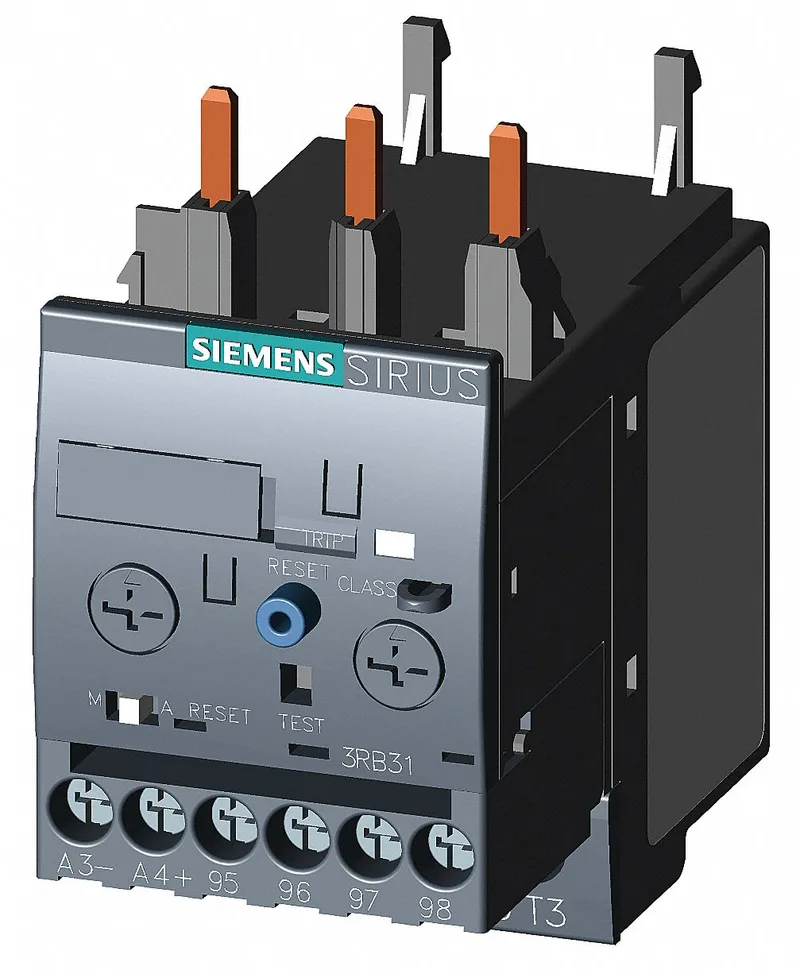
Siemens 3RB3123-4SB0 SIRIUS solid-state overload relay, S0
Siemens SIRIUS 3RB3123-4SB0 solid-state overload relay, size S0, 12 A thermal current, 690 V rated, adjustable trip class 5E/10E/20E/30E, screw terminals, contactor mounting.
Specifications
| Parameter | Value |
|---|---|
| Product brand name | SIRIUS |
| Product designation | solid-state overload relay |
| Frame size (overload relay) | S0 |
| Combinable contactor sizes | S0 |
| Reference code (IEC 81346-2) | F |
| Parameter | Value |
|---|---|
| Overload current setting range | 3 ... 12 A |
| Trip class | CLASS 5E, 10E, 20E and 30E adjustable |
| Overload release type | electronic |
| Parameter | Value |
|---|---|
| Rated operational current | 12 A |
| Poles (main circuit) | 3 |
| Rated operating frequency | 50 ... 60 Hz |
| Rated insulation voltage (AC, pollution degree 3) | 690 V |
| Rated value (AC-3e), max. | 690 V |
| Rated surge withstand voltage | 6 kV |
| Main current circuit | screw-type terminals |
| Power loss at rated current (hot) | 0.6 W |
| Per pole | 0.2 W |
| Parameter | Value |
|---|---|
| Auxiliary contacts: NO | 1 |
| Auxiliary contacts: NC | 1 |
| Auxiliary contacts: CO (changeover) | 0 |
| Auxiliary switch short-circuit protection (required fuse) | fuse gG: 6 A |
| Switching current at 24 V | 2 A |
| Switching current at 60 V | 0.55 A |
| Switching current at 110 V | 0.3 A |
| Switching current at 120 V | 4 A |
| Switching current at 125 V | 0.3 A |
| Switching current at 220 V | 0.11 A |
| Switching current at 230 V | 3 A |
| Parameter | Value |
|---|---|
| Mounting / fastening method | Contactor mounting |
| Mounting position | any |
| Main-circuit connector arrangement | Top and bottom |
| Auxiliary/control circuit connection type | screw-type terminals |
| Removable aux./control terminal | Yes |
| Conductor cross-section: solid | 1x (0.5 ... 4 mm²), 2x (0.5 ... 2.5 mm²) |
| Conductor cross-section: solid or stranded | 1x (0,5 ... 4 mm²), 2x (0,5 ... 2,5 mm²) |
| Conductor cross-section: finely stranded with ferrule | 1x (0.5 ... 2.5 mm²), 2x (0.5 ... 1.5 mm²) |
| Conductor range (AWG), auxiliary contacts | 1x (20 ... 14), 2x (20 ... 14) |
| Parameter | Value |
|---|---|
| Operating temperature | -25 ... +60 °C |
| Storage temperature | -40 ... +80 °C |
| Transport temperature | -40 ... +80 °C |
| Relative humidity, operating | 10 ... 95 % |
| Max. installation altitude | 2 000 m |
| Shock resistance | 15g / 11 ms |
| Parameter | Value |
|---|---|
| Width | 45 mm |
| Height | 87 mm |
| Depth | 84 mm |
Product details
Frequently asked questions
What does the note 'for message tripped' mean on this overload relay?
The note indicates that the signaling contact (terminals 97/98) changes state when the relay trips from an overload condition — it is a dry-contact output that can drive a PLC input, alarm, or status lamp to indicate the motor has been disconnected by the overload protection.
What trip classes are available on the 3RB3123-4SB0?
The trip class is adjustable to CLASS 5E, 10E, 20E, or 30E — selectable via a dial on the relay face, letting you match the protection curve to the motor's acceleration time without stocking multiple fixed-class relays.
Will the 3RB3123-4SB0 fit a panel designed for a 3RV2021-1GA15?
No — the 3RB3123-4SB0 is a solid-state overload relay in size S0 (45 mm wide) designed to mount directly on a contactor, while the 3RV2021-1GA15 is a motor circuit breaker with a different footprint and mounting method. They are not mechanically interchangeable without rewiring the panel layout.
S0 form factor, contactor-mount, adjustable trip class
The Siemens 3RB3123-4SB0 is a SIRIUS solid-state overload relay in the S0 size class, measuring 45 mm wide, 87 mm high, and 84 mm deep — a footprint that fits standard S0 contactor mounting rails without extra DIN-rail hardware. Its key differentiator is the adjustable trip class: selectable between CLASS 5E, 10E, 20E, and 30E, which lets the same relay cover both fast-acting protection for short-time rated motors and slower curves for high-inertia loads that need longer acceleration without nuisance tripping.
Thermal rating and motor current setting window
Rated thermal current is 12 A at 690 V, with the same 12 A rating at 480 V and 600 V — no derating across common industrial voltage levels up to 690 V. The overload detection logic triggers when motor current exceeds the upper current setting value multiplied by 3.5, and resets when current drops below the lower setting value — this 3.5× threshold means the relay tolerates startup inrush without false trips as long as the motor stays within the setting range. Power dissipation is 0.2 W per pole, which keeps the heat load low inside a crowded panel — at 12 A continuous, three poles dissipate 0.6 W total, negligible for enclosure thermal budgeting.
Auxiliary contact ratings across control voltages
The signaling contact (97/98) is rated 2 A at 24 V, 4 A at 120 V, and 3 A at 230 V — these are the current-carrying limits for the tripped-indication circuit feeding a PLC input or alarm lamp. At 60 V the contact handles 0.55 A, at 110 V and 125 V it handles 0.3 A, and at 220 V it handles 0.11 A — the contact rating follows a clear inverse voltage-current curve, so for 24 VDC control circuits the full 2 A is available, while higher-voltage DC circuits must be derated accordingly.
Environmental endurance and vibration resistance
Shock resistance is 15g for 11 ms on the main body, with the signaling contact derated to 9g for 11 ms in the tripped position — this matters for mounting on a contactor that sees repetitive shock from switching large loads. Vibration resistance spans 1-6 Hz at 15 mm amplitude and 6-500 Hz at 20 m/s² for 10 cycles, which covers the typical spectrum found on motor control center panels near large rotating equipment.
Termination and wiring capacity
The control circuit accepts up to 2x 10 mm² stranded wire for the larger auxiliary connections, with a Pozidriv PZ 2 screwdriver tip specified — the 5 to 6 mm shaft diameter means a standard electrician's screwdriver fits without adapters.