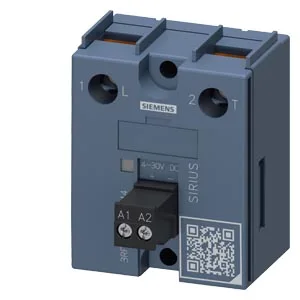
For motor or resistive heating loads, that figure assumes proper heatsinking and ambient temperature within the rated range — the 45 mm width gives enough surface area for moderate loads, but if you're pushing near the limit in a tightly packed enclosure, you'll want to check the derating curve. The 48-460 V AC range covers common industrial voltages including 120 V, 208 V, 240 V, 277 V, 400 V, and 480 V systems. The 4-30 V DC control input is compatible with standard 24 V DC PLC outputs and most DC logic levels.
No export restrictions apply (AL: N, ECCN: N).
What to watch when installing
For the DC control side, keep the wiring separate from the power cables to avoid noise injection — the solid-state switch is fast, and a coupled transient can fire the gate if the control pair runs parallel to the load wires in the same duct. The 50 A rating is for resistive loads. If you're switching motors or transformers, the inrush current can be several times the steady-state rating, so either oversize the relay or add a soft-start circuit upstream. For a 3 kW motor on 400 V, the running current is about 6.5 A, but the inrush might hit 40 A for a few cycles — this relay handles that, but continuous operation near 50 A on an inductive load will need a heat sink and good airflow.