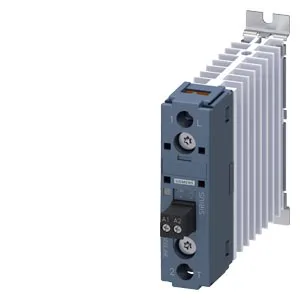
The Siemens 3RF3320-1DA04 is a 1-pole SIRIUS 3RF33 solid-state contactor rated for AC-1 resistive loads at 20 A and 40 °C ambient, with a load voltage range of 48-460 V and a 24 V DC control voltage. It is designed for switching resistive heating elements, lighting banks, or other non-inductive loads where silent, wear-free switching matters — no coil hum, no contact bounce, no arcing. The screw terminals make it straightforward to wire in a panel; the 24 V DC control side is common in PLC-driven cabinets. The part is listed as short-circuit-proof when paired with a B-curve miniature circuit breaker, which simplifies protection coordination — you don't need to oversize the breaker to handle inrush, because solid-state switching has none. That B-curve MCB covers the semiconductor's fault current capability without nuisance tripping on normal operation.
RoHS compliance is confirmed since January 2024, and REACH Article 33 declares lead (CAS 7439-92-1) above 0.1% w/w in the current candidate list. For a BOM freeze or compliance audit, that lead declaration means the part carries the standard EU substance notification — it does not block sale but must be documented in the supply chain.
What the AC-1 rating means for fit
If you are switching motor loads (AC-3 or AC-4), the current must be derated significantly; this 1-pole solid-state contactor is not a general-purpose motor starter. The 48-460 V load voltage range covers common single-phase line voltages from 48 V control circuits up to 460 V industrial supplies. The 24 V DC control voltage is standard for modern PLC outputs; the solid-state input draws minimal current and has no coil to hold in, so it is compatible with low-current digital outputs from a controller. No suppression diode needed across the control terminals — there is no inductive kickback from a coil.
Packaged at 105 x 27 x 122 mm, this single-pole contactor snaps onto a DIN rail — standard TS35 profile. The 27 mm width means it takes up one standard modular device slot on the rail, leaving room for the associated B-curve MCB alongside.