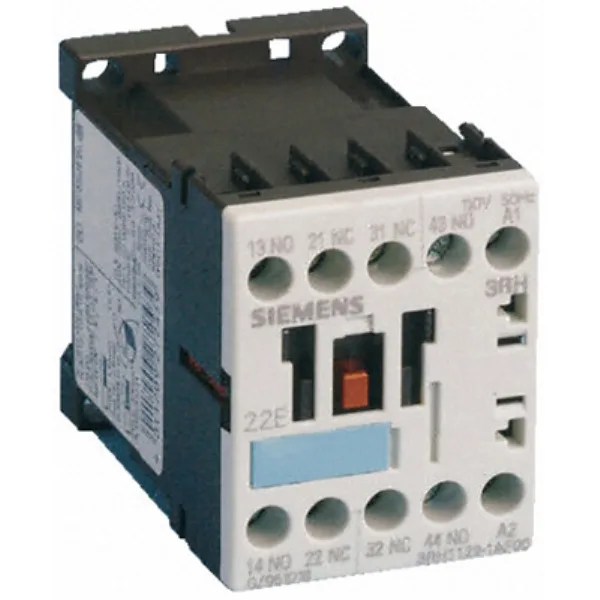
It carries 2 normally open (NO) instantaneous contacts, rated at 10 A at 24 V, 6 A at 230 V, and 1 A at 690 V — meaning it handles everything from PLC-level pilot duty up to higher-voltage interlock circuits in a panel. Mounting is by screw or snap-on onto a DIN rail.
The contact reliability spec tells you this contactor is rated for one incorrect switching operation per 100 million cycles at 17 V and 1 mA — that's a dry-circuit rating, meaning it'll reliably switch low-energy signals from sensors or PLC outputs without needing a minimum wetting current. If you're using it to drive a contactor coil or a small relay, that's not a concern; but if you're switching a dry logic signal, this part won't bounce or fail to make contact. This helps the contactor handle transient spikes without flashover.
Mechanical endurance and wiring
Shock resistance is 10g for 5 ms and 5g for 10 ms. Terminals accept solid conductors from 0.5 mm² up to 4 mm², with multiple combinations: two wires of 0.5–1.5 mm², two of 0.75–2.5 mm², or a single 4 mm². That's enough for daisy-chaining control wiring or landing a heavier common feed. The product extension auxiliary switch flag means this contactor accepts add-on auxiliary contact blocks if you need more than the built-in 2 NO.
RoHS compliance date is noted as July 1, 2006, meaning it meets the original RoHS directive. No REACH or UL listing is explicitly stated in the evidence, so verify those against your local compliance requirements before committing the BOM line.