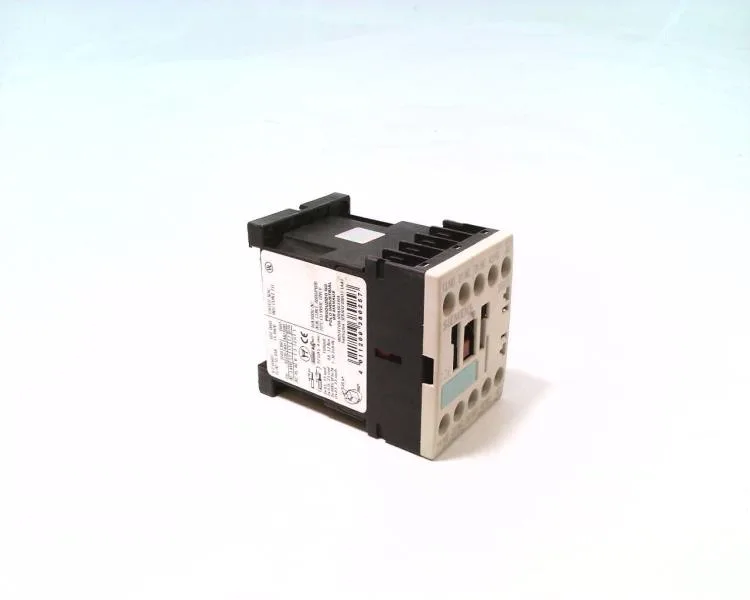
It carries 2 instantaneous NO contacts (no delayed, lagging, or make-before-break switching) and is rated for a surge voltage of 6 kV, which means it can handle typical transient spikes in industrial 400/690 VAC control circuits without flashover. The front face carries IP20 protection, so it's safe for finger contact in a standard IP54/IP55 cabinet.
The contactor is rated for a range of control voltages and currents: at 24 V it switches 10 A, at 110 V it switches 1 A, at 230 V it switches 6 A, at 400 V it switches 3 A, and at 690 V it switches 1 A. These are the thermal current ratings for the auxiliary contacts — the 6 A at 230 V is the most common for 24 VDC/230 VAC control circuits, while the 3 A at 400 V and 1 A at 690 V cover higher-voltage signal switching in motor starter applications. Mechanical endurance is typical 30 million operations, and the contactor survives shock at 10g / 5 ms and 5g / 10 ms — suitable for mounting on a vibrating machine frame or in a panel near a large contactor. Operating temperature range is -25 to +60 °C, storage -55 to +80 °C, and pollution degree 3 means it's rated for conductive pollution typical in industrial environments (not clean-room or office).
The 3RH1122-1AG10 occupies a 45 mm width on the DIN rail, with a depth of 72 mm and height of 57.5 mm — it fits the standard S00 footprint shared by the 3RT10 contactor series. The auxiliary switch can be extended (product extension auxiliary switch = Yes), so you can add more contact blocks on top if needed. Terminals accept solid wire: 2x (0.5 to 1.5 mm²), 2x (0.75 to 2.5 mm²), and 2x 4 mm², or AWG 2x (20 to 16), 2x (18 to 14), and 1x 12. This covers most control wiring from signal to power circuits; the dual-wire entry allows daisy-chaining without extra terminals.
The part is RoHS compliant per the substance prohibition date of 01.07.2006, and carries the reference code K per IEC 81346-2. For compliance documentation (CE, UL, CSA), the SIRIUS family typically holds those approvals, but specific certification marks are not listed in this record — verify with the full datasheet if your project requires a specific mark.