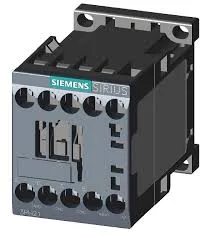
Its contact complement is 2 normally-open and 2 normally-closed instantaneous contacts, with no leading, delayed, or make-before-break options — a straightforward 2 NO / 2 NC block for standard interlocking and status feedback. The AC-12 rated operating current is 10 A at 24 V, which covers most 24 VDC control loads and pilot-duty circuits; at 230 V AC the rating drops to 6 A, and at 400 V AC to 3 A, so the actual switching capacity depends on the control voltage in your panel.
The contactor mounts via both screw-fixing and snap-on onto a 35 mm DIN rail — the standard for European control panels — and occupies a 45 mm width footprint, with a 57.5 mm height and 72 mm depth that fits the S00 envelope common to SIRIUS auxiliary and power contactors. Snap-on mounting means it clicks directly onto the DIN rail alongside a SIRIUS power contactor (e.g. 3RT2 series) without extra hardware; the screw-fixing option is there if vibration or shock is a concern in the specific enclosure. The screw terminals accept solid conductors from 0.5 mm² up to 4 mm² per clamp — 2x (0.5...1.5 mm²), 2x (0.75...2.5 mm²), or 2x 4 mm² — so you can land two smaller control wires or one larger one per terminal, which is typical for daisy-chaining auxiliary circuits.
Shock resistance is 10 g for 5 ms and 5 g for 10 ms per the spec, which covers most industrial vibration environments, including conveyor drives and pump stations, as long as the mounting is secure. Mechanical endurance is given as 30 million operating cycles typical — this is the mechanical life without load, so in a real control circuit switching 10 A at 24 VDC you'll get fewer cycles, but the contactor is built for high-duty signalling applications like machine cycle counters or safety chain interlocks.