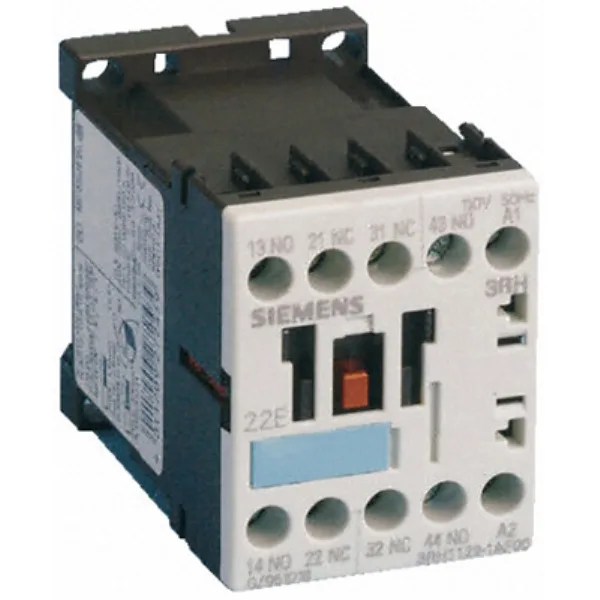
It gives you four normally-open and two normally-closed instantaneous contacts, all rated for the same 6 kV surge voltage withstand. That matters when you're shoehorning it into a crowded panel and the wireway forces an odd orientation.
Contact ratings — what they actually mean for your circuit
The 10 A at 24 V rating is the headline number, but the real story is the derating curve as voltage climbs: 6 A at 230 V, 3 A at 400 V, and only 1 A at 690 V. If you're switching a 400 V control transformer or a valve solenoid on a 230 V line, use the corresponding column — not the 24 V figure. For DC switching the numbers drop faster: 1 A at 110 V, 0.27 A at 220 V. That's typical for a contactor this size — arc extinction in DC is harder. If your circuit is 125 VDC, the 110 V rating is the closest guide; don't extrapolate linearly. For dry-contact PLC inputs or low-voltage signal paths, this contactor is trustworthy.
Mechanical endurance and environmental limits
Electrical life depends on the switched current and voltage; for a 24 VDC relay coil or a 230 VAC contactor coil, expect millions of operations before contact wear becomes an issue. Shock resistance is 10 g for 5 ms and 5 g for 10 ms — fine for most industrial panels, but if the panel is on a vibrating conveyor or a press, check the mounting and add support.
Each terminal accepts solid or stranded copper: two conductors of 0.5 to 1.5 mm², two of 0.75 to 2.5 mm², or two of 4 mm². That covers most control wiring from signal-level pairs up to a 4 mm² feed. Dimensions are 45 mm wide, 57.5 mm tall, 72 mm deep — S00 frame.
RoHS compliance date is July 1, 2006, which covers the EU RoHS directive. Substance prohibitance is declared per that date; no REACH or UL listing is explicitly stated in the spec table, but the SIRIUS series typically carries UL and CSA certification — verify the specific approval mark on the nameplate if your project requires it.