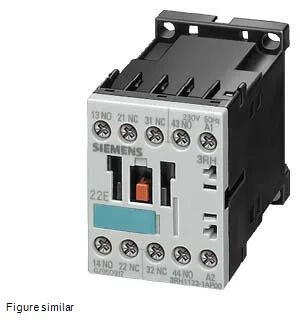
It's the part you reach for when a PLC output needs to drive a contactor coil, a status light, or a signal to a DCS, and you need galvanic isolation between the logic side and the load side. Rated at 10 A at 24 V and 6 A at 230 V, this covers the vast majority of 24 VDC relay and indicator loads you'll find in a modern panel. At 690 V it still switches 1 A, so it'll handle a 400 V contactor coil or a small valve actuator without breaking a sweat.
Mounting and wiring reality
It's 45 mm wide and 72 mm deep — that's a standard S00 footprint, so it clips onto the same 35 mm DIN rail as any other SIRIUS block. The screw and snap-on mounting means you can either screw it down or snap it onto the rail; in a tight panel where you're swapping a failed unit, the snap-on saves you pulling the whole rail. Terminal capacity: 2x (0.5 to 1.5 mm²), 2x (0.75 to 2.5 mm²), and 2x 4 mm² solid. That's two conductors per clamp on the smaller gauges — handy for daisy-chaining common signals. If you're wiring a 24 V common rail through the contactor, you can land two 1.5 mm² wires in one terminal and keep the daisy chain tidy.
Contact reliability and switching life
The contact reliability spec is one incorrect switching operation per 100 million at 17 V, 1 mA. That's the gold standard for PLC-level signals — it means this contactor won't miss a dry-contact closure from a sensor or a low-current PLC output. For a 24 VDC signal chain, that's the number that matters more than the 10 A rating. That's a lot of cycles for an auxiliary contactor — you'd wear out a machine long before this block gives up.
Shock resistance is 10g / 5 ms and 5g / 10 ms — fine for industrial machinery but not for a hammer mill direct mount. RoHS compliance date is 2006-07-01, so it's fully RoHS compliant and REACH-compliant by extension. No substance prohibitance issues for current builds.