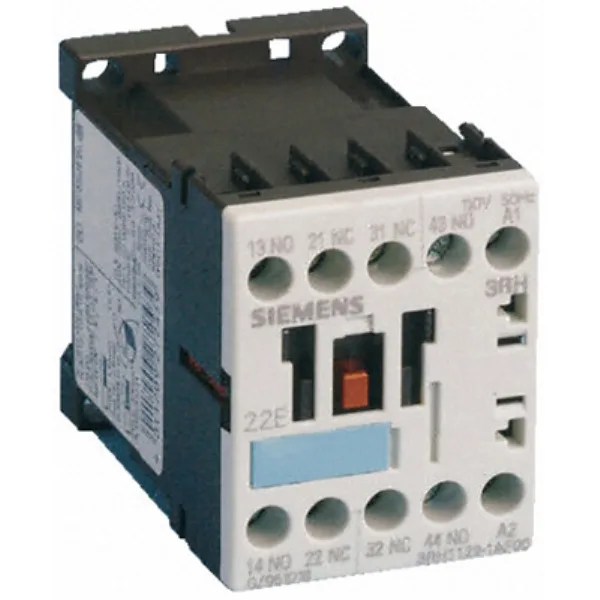
The Siemens 3RH1122-1AP00-ZW96 is a SIRIUS auxiliary contactor in the size S00 frame — the smallest footprint in the SIRIUS family, at 45 mm wide, 57.5 mm tall, and 72 mm deep. It's built for control-circuit switching, not motor loads: the 10 A rating at 24 V tells you it handles PLC outputs, relay coils, and signal-level loads, not the main power path. The IP20 front protection means it's meant for enclosed panels, not washdown zones.
The 6 kV surge voltage resistance (rated impulse withstand) is the number that matters for panel coordination — it means this contactor can sit on a 400 VAC control transformer secondary without needing extra MOVs, as long as the upstream breaker limits let-through energy. The 10 A at 24 V is the thermal current (Ith), but the real switching capacity drops with voltage: 6 A at 230 V, 3 A at 400 V, 1 A at 690 V. If you're switching a 24 VDC relay bank, the 10 A holds; for a 230 VAC pilot light string, derate to 6 A. The mechanical endurance of 30 million operations (typical) means it outlasts most panels.
Mounting and wiring realities
The auxiliary switch block is field-expandable (product extension auxiliary switch = yes), so you can add more N.O./N.C. contacts later without swapping the base unit.