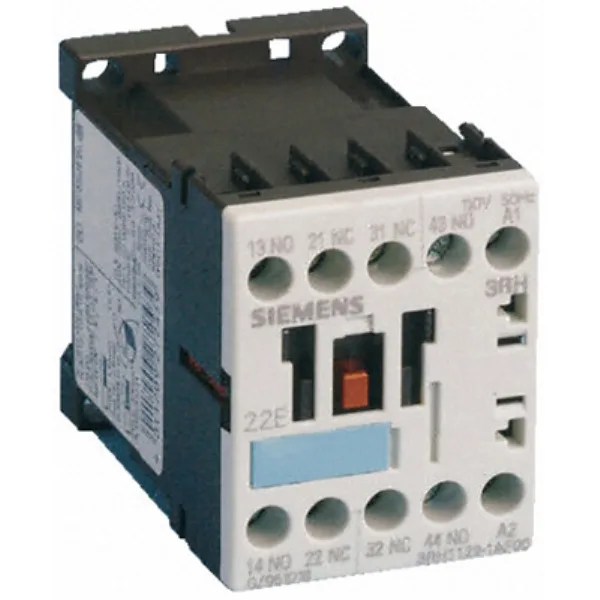
Rated operational current drops with voltage as you'd expect: 6 A at 230 V, 3 A at 400 V, 2 A at 500 V, 1 A at 690 V. That's the same contact stack, just derated by the switching arc energy. For 110 V control circuits it's rated 1 A. These numbers come from the maker's own table — match the voltage on your BOM line to the right row before you commit the part.
Fastens with a screw or snaps onto a DIN rail — pick whichever the panel layout prefers. The 45 mm width and 57.5 mm height fit the standard S00 footprint; depth is 72 mm including clearance for the terminals. Terminal accepts solid conductors: 2x 0.5–1.5 mm², 2x 0.75–2.5 mm², or 2x 4 mm². AWG equivalents are 2x 20–16, 2x 18–14, or 1x 12. That's enough cross-section for daisy-chaining through multiple aux contacts without a separate terminal block.
RoHS compliance date is marked as July 1, 2006, which aligns with the EU RoHS directive. That's typical for industrial control panels but worth noting if the environment is unusually dusty or humid.