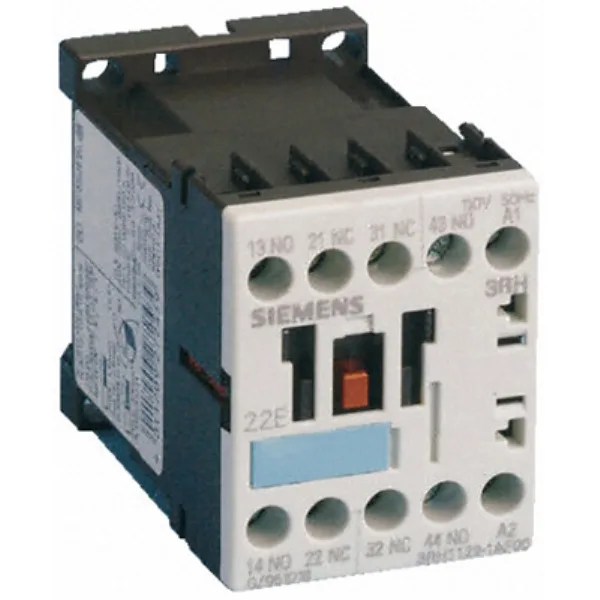
It carries 2 normally-open and 2 normally-closed instantaneous contacts, with no leading, lagging, delayed, or make-before-break switching — a straightforward 2 NO + 2 NC block for standard interlocking or signaling. The coil is rated for 60 V DC, drawing 3.2 W during both closing and holding — no power drop-off once it's pulled in, so the coil supply stays loaded at 3.2 W continuously. That matters for DC-supply budgeting in a panel with multiple contactors.
The auxiliary contacts are rated by voltage: 10 A at 24 V, 6 A at 230 V, 3 A at 400 V, 2 A at 500 V, and 1 A at 690 V. Those are thermal current ratings for the contact block — they tell you the maximum continuous current the contacts can carry at each voltage level. For a 24 V DC PLC output interposing relay, you've got 10 A headroom; at 230 V AC control voltage, you're limited to 6 A. The 1 A at 690 V rating is for high-voltage control circuits, not power switching. If you're switching dry contacts (PLC inputs, low-voltage signals), this contactor handles it without needing gold-plated contacts.
Wire capacity covers solid and stranded: 2x 0.5–1.5 mm², 2x 0.75–2.5 mm², or 2x 4 mm² per terminal. For AWG: 2x 20–16, 2x 18–14, or 1x 12. That's enough for daisy-chaining control wiring through the contact block without pigtails.
Shock resistance is 10g for 5 ms and 5g for 10 ms — sufficient for normal industrial vibration but not rated for heavy impact near crushers or presses. RoHS compliance date is July 1, 2006 — the part is RoHS-compliant by the EU directive.