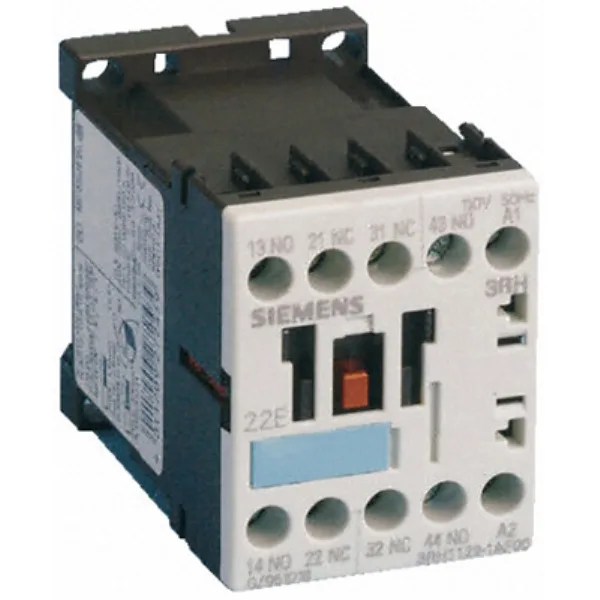
What it is and where it fits
The Siemens 3RH1122-1BN40-0AA6 is a SIRIUS auxiliary contactor — a compact switching block meant to extend the control-circuit contacts on a motor contactor or to act as a standalone signal relay in a panel. It carries 2 NO and 2 NC instantaneous contacts, rated for 10 A at 24 V and derated to 1 A at 690 V, so it handles both low-level PLC signals and moderate pilot-duty loads. The 45 mm width and size S00 frame let it snap onto a DIN rail alongside a matching contactor without eating extra panel space.
Key ratings and what they mean for fit
The 24 V rated current of 10 A is the headline figure — it tells you the contact set can switch a 24 VDC control load like a small solenoid valve or a PLC input module without derating. At 230 V the rating drops to 6 A, and at 690 V it's 1 A, so for higher-voltage control circuits you size by the lower number. The surge voltage resistance of 6 kV means the contacts are insulated to withstand transients common in industrial panels fed from 400 V distribution — no extra snubber needed for basic motor starter circuits. Contact reliability is specified as one incorrect switching operation per 100 million operations at 17 V, 1 mA — that's the gold standard for dry-circuit signals. If you're switching a 24 VDC proximity sensor or a relay coil, the contacts won't gum up from low energy. The mechanical life of 30 million operations means the armature and spring set will outlast most panel revisions.
Mounting and wiring
Mounting is screw and snap-on — the 45 mm body clips onto a 35 mm DIN rail and can also be screwed to a backplate. The mounting position is flexible: +/-180° rotation on a vertical surface, plus +/-22.5° tilt forward and backward, which helps when you're routing wires in a crowded enclosure. The front protection class is IP20, so it's safe for finger contact inside a closed panel but not for washdown areas. Terminals accept solid conductors from 0.5 mm² up to 4 mm² (two wires per clamp for smaller sizes), and AWG equivalents from 20 to 12. That covers standard control wiring — 1.5 mm² for most 24 V circuits, 2.5 mm² for longer runs. The depth of 72 mm leaves room behind the DIN rail for cable ducts.
