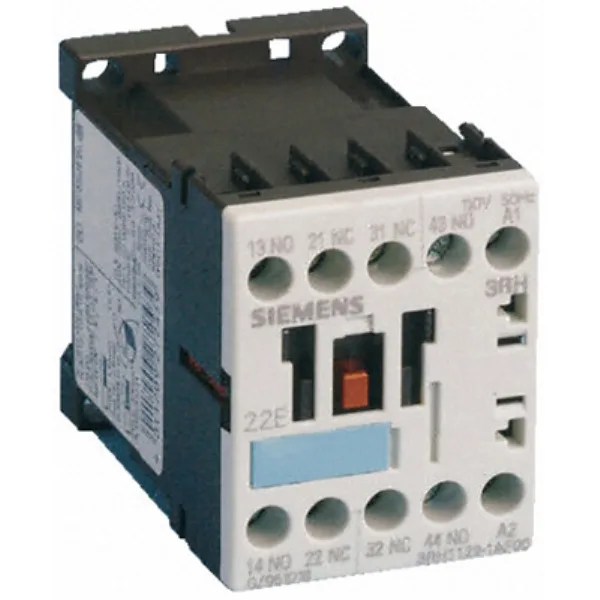
The Siemens 3RH1122-1HB40 is a SIRIUS coupling relay designed for switching auxiliary circuits in control panels. It carries a 24 V DC coil with a holding power of 2.3 W, and its contacts are rated for 10 A at 24 V — enough for pilot-duty loads like contactor coils, indicator lamps, and PLC inputs. The 2 NO instantaneous contacts (no leading, lagging, or delayed switching) mean it closes and opens in step with the coil, which is what you want for straightforward interlock or signal-repeat functions. Size S00 (45 mm wide, 57.5 mm tall, 72 mm deep) and screw-and-snap-on mounting let it land on a standard DIN rail in a crowded panel without eating up extra width.
For inductive DC loads (contactors, solenoids), you'll need to derate; the part's own switching capacity at higher voltages drops to 1 A at 110 V, 0.27 A at 220 V, and 1 A at 690 V, which tracks the typical DC-13 derating curve. The 6 kV surge voltage resistance (rated impulse withstand) means it can handle transient spikes on a 400 V industrial network without flashover — important for panel builders coordinating with upstream surge protection. That's the dry-circuit (low-energy) reliability figure — it tells you the silver-alloy contacts are designed to switch logic-level signals without needing a wetting current, which is why this relay is often used to isolate PLC outputs from the power circuit. The 10g / 5 ms and 5g / 10 ms shock resistance, combined with the wide operating temperature range of -25 to +60 °C, makes it suitable for machine-tool cabinets and conveyor-line panels where vibration and ambient heat are present.