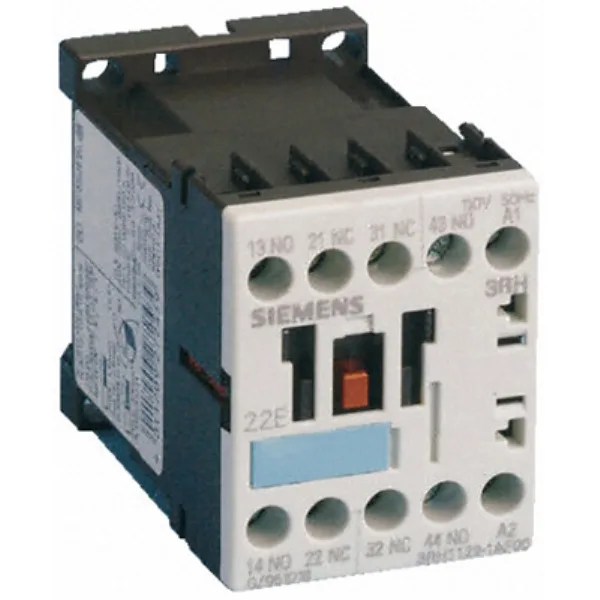
The Siemens SIRIUS 3RH1122-1KE40 is a coupling relay built for switching auxiliary circuits in control panels. Rated at 60 V with a 10 A switching capacity at 24 V, it handles the auxiliary loads common in motor starter and PLC output isolation circuits. The 6 kV surge voltage resistance means it can sit on the same rail as contactors without coupling noise back into the control logic.
At higher voltages the current drops: 1 A at 110 V, 0.27 A at 220 V, 6 A at 230 V, 3 A at 400 V, 2 A at 500 V, and 1 A at 690 V. These are the AC-15 / DC-13 style derating curves you need when sizing for mixed-voltage control circuits. The typical mechanical life is 30,000,000 operations. The built-in varistor surge suppressor (design of the surge suppressor: with varistor) clamps coil transients at source, so you don't need an external flyback diode or RC snubber on the relay coil. Coil closing and holding power is a steady 2.3 W DC.
Shock resistance is 10g at 5 ms and 5g at 10 ms — adequate for machine-mounted panels but not for direct hammer-mill attachment without isolation. The screw terminals accept solid conductors from 0.5 mm² up to 4 mm² (2x 0.5...1.5 mm², 2x 0.75...2.5 mm², 2x 4 mm²).