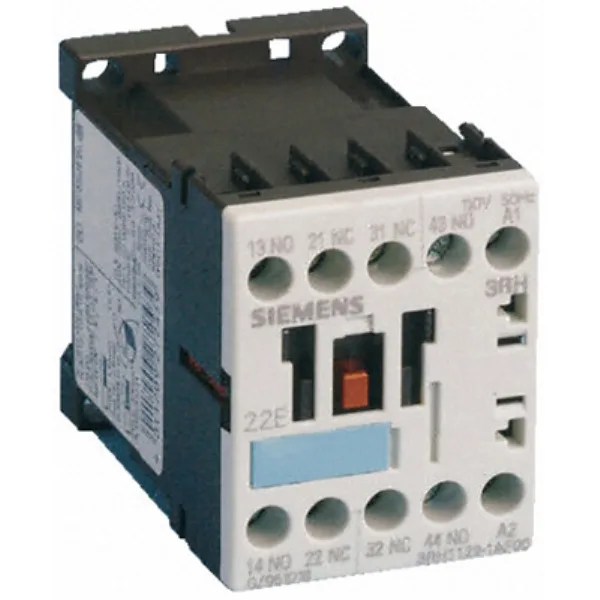
The Siemens 3RH1122-2JC40 is a SIRIUS coupling relay — a Size S00 contactor-form relay designed for switching auxiliary circuits, not motor loads. Its job is to pass control signals (pilot devices, PLC outputs, safety circuit commands) to the coil of a larger contactor or to a load in a 24–690 VAC control scheme. That matters when you're squeezing it into a crowded panel alongside the main contactor it drives.
The relay carries 2 normally-open and 2 normally-closed instantaneous contacts. The headline rating is 10 A at AC-12 — that's the resistive-load switching capacity at 24 V. But the real-world switching capability depends on the voltage you're working at: 6 A at 230 V, 3 A at 400 V, 2 A at 500 V, and 1 A at 690 V (–). At 110 V it's 1 A; at 220 V, 0.27 A. These are the AC-15/DC-13 style ratings for inductive loads — the numbers that govern whether the relay holds up switching a contactor coil or a solenoid valve. The coil itself is DC-operated with an integrated diode surge suppressor. Closing and holding power are both 2.3 W DC — a steady-state draw that stays constant, so no inrush spike to budget for in your 24 VDC supply. The coil holds at 24 V nominal; the operating range covers -25 to +60 °C ambient.
The screw terminals accept 2x (0.25 to 2.5 mm²) solid or stranded wire. Front protection is IP20; side clearances are 0 mm, meaning you can butt it against adjacent devices without derating. Shock resistance is 10g / 5 ms and 5g / 10 ms.