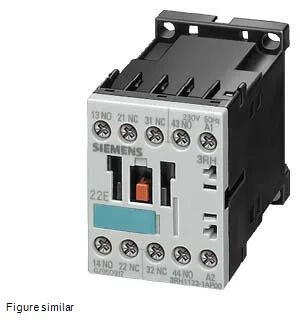
It carries three normally open instantaneous contacts (3 NO) and no delayed or lagging switching. The coil is rated for 24 V at both 50 Hz and 60 Hz, with a tolerance band of 0.8–1.1 at 50 Hz and 0.85–1.1 at 60 Hz, so it holds in across a saggy line but drops out cleanly below the undervoltage threshold.
The 3RH1131-1AB00-1AA0's contact ratings are given per voltage, not as a single thermal current. At 24 V it switches 10 A; at 230 V it switches 6 A; at 400 V it drops to 3 A; at 690 V it handles 1 A. That derating curve is typical for an auxiliary contactor — the arc-extinction gap is fixed, so higher voltage reduces the current the contacts can break. For a 24 VDC pilot circuit the 10 A rating is generous; for a 230 VAC signal lamp string the 6 A limit governs. The 1 A at 690 V tells you this part can switch a 690 V control transformer primary, but only at low current. If you are switching PLC digital inputs or relay coils in the milliampere range, this contactor will not give you intermittent opens.
Mechanical endurance and environmental limits
Shock resistance is 10g for 5 ms and 5g for 10 ms, which covers most industrial vibration environments short of a stamping press or crusher.
Wiring and compliance
The screw terminals accept solid conductors: two per clamp for 0.5–1.5 mm², two for 0.75–2.5 mm², and a single 4 mm². RoHS compliance date is July 1, 2006 — the part was designed to meet the original EU RoHS directive. No UL or CSA listing appears in the evidence, so verify with your local Siemens office if a UL 508 listing is required for your panel.