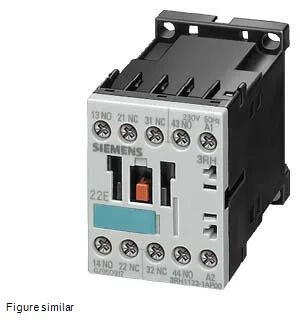
The 3 NO + 1 NC configuration is a standard pick for extending the auxiliary contact count on a main contactor or for building interlock logic in a panel.
Fastens via screw and snap-on mounting onto a DIN rail. The S00 footprint is 45 mm wide, 57.5 mm high, 72 mm deep. IP20 front.
The headline 10 A at AC-12 tells you this contactor can switch resistive loads at up to 10 A — that's the rating for control transformers, solenoid valves, and contactor coils. For inductive DC loads the ratings drop significantly: 10 A at 24 V DC, but only 1 A at 110 V DC, 0.27 A at 220 V DC. At 230 V AC (50 Hz) it handles 6 A, and at 400 V AC it's rated 3 A. The contact reliability spec — one incorrect operation per 100 million cycles at 17 V, 1 mA — means it's trustworthy for low-energy PLC input circuits where oxide film on dry contacts can cause intermittent faults.
Terminals accept solid conductors from 0.5 mm² up to 4 mm² (or 2x 0.5–1.5 mm² and 2x 0.75–2.5 mm²), with AWG equivalents of 20–16, 18–14, and 12 for the larger single conductor. Shock resistance is rated at 10g for 5 ms and 5g for 10 ms — fine for most industrial machinery but worth noting if the panel mounts directly on a vibrating press or conveyor drive.