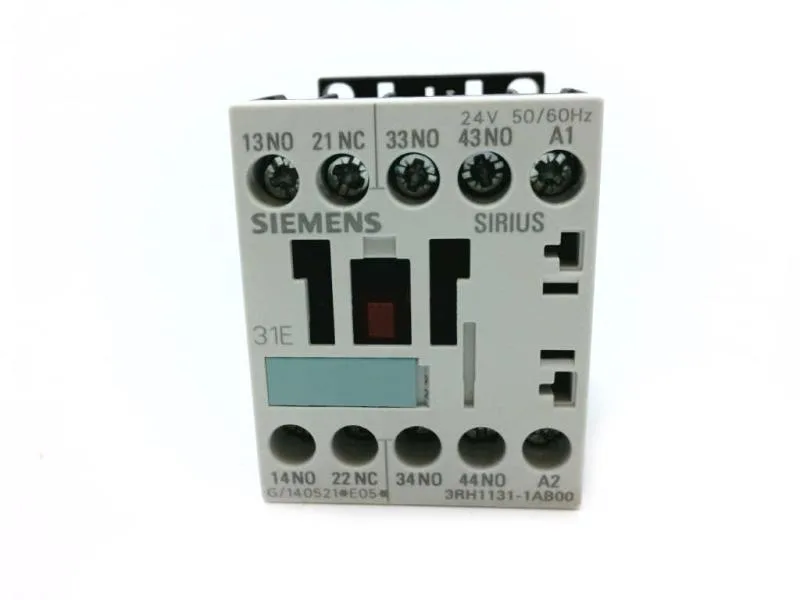
It's the switching element for control circuits — think PLC outputs driving contactor coils, signal interlocking, or status feedback in a motor control center.
The three NO contacts are rated for different currents depending on the voltage they switch. At 24 V the contact carries 10 A; at 230 V it's 6 A; at 400 V it drops to 3 A; at 690 V it's 1 A. For DC switching, at 110 V it handles 1 A, at 220 V it's 0.27 A. These are the thermal continuous ratings — the contact can hold that current indefinitely without overheating.
The screw terminals accept solid conductors: two wires of 0.5 to 1.5 mm², two of 0.75 to 2.5 mm², or a single 4 mm². That covers most control-circuit wiring in a panel — 1.5 mm² for signal runs, 2.5 mm² for short power feeds. The IP20 front protection keeps fingers out but doesn't seal against dust or moisture, so it's for indoor panel use only.
Shock resistance is 10g for 5 ms and 5g for 10 ms, which covers most industrial vibration environments. The part is RoHS-compliant per the substance prohibition date of July 1, 2006. The lifecycle stage is current production.