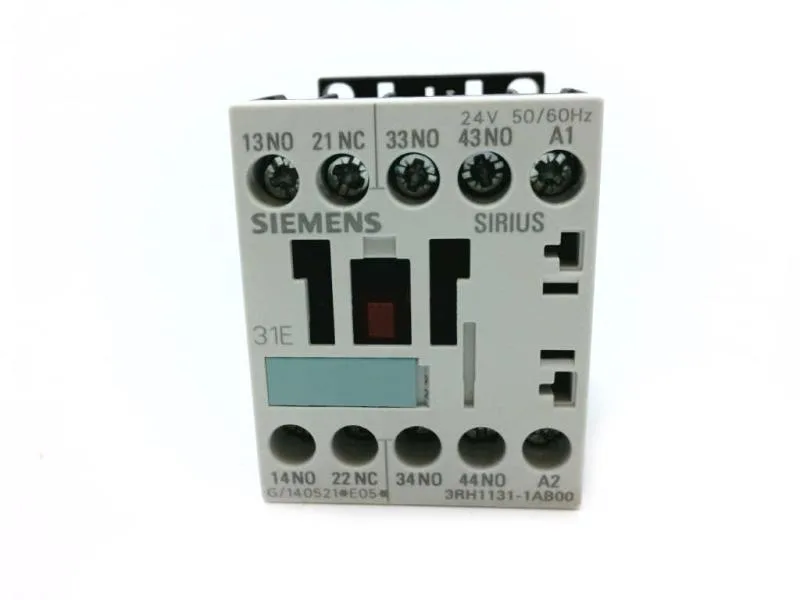
The Siemens 3RH1131-1AS00 is a SIRIUS auxiliary contactor in the S00 frame size — the smallest footprint in the SIRIUS contactor family, at 45 mm wide, 57.5 mm tall, and 72 mm deep. It provides three normally open instantaneous contacts (no delayed or lagging switching) and is designed for control-circuit switching, not main motor loads.
Switching capacity — what the voltage-dependent ratings mean
The 3RH1131-1AS00 carries a rated insulation voltage of 500 V AC (50/60 Hz) and a surge voltage resistance of 6 kV, which puts it in the standard control-circuit insulation class for 400 V line-fed panels. The switching current is voltage-dependent: at 24 V it handles 10 A, at 110 V it drops to 1 A, at 230 V it is rated 6 A, and at 400 V it switches 3 A. At 690 V the rating falls to 1 A. These are the thermal current ratings for the contacts — the actual make/break capacity for inductive loads like contactor coils or relay coils will be lower, so size the load against the AC-15 or DC-13 utilization category if the application involves solenoids or motor contactor coils.
Mounting, wiring, and environment
Shock resistance is 10g / 5 ms and 5g / 10 ms — adequate for standard industrial panel vibration but not for direct mounting on a high-impact machine frame.
Contact reliability and endurance
Mechanical endurance is 30 million switching operations typical. For a pulp and paper mill running consistency loops or dryer-section controls, that low-level reliability keeps the machine running without nuisance faults from contact oxidation.