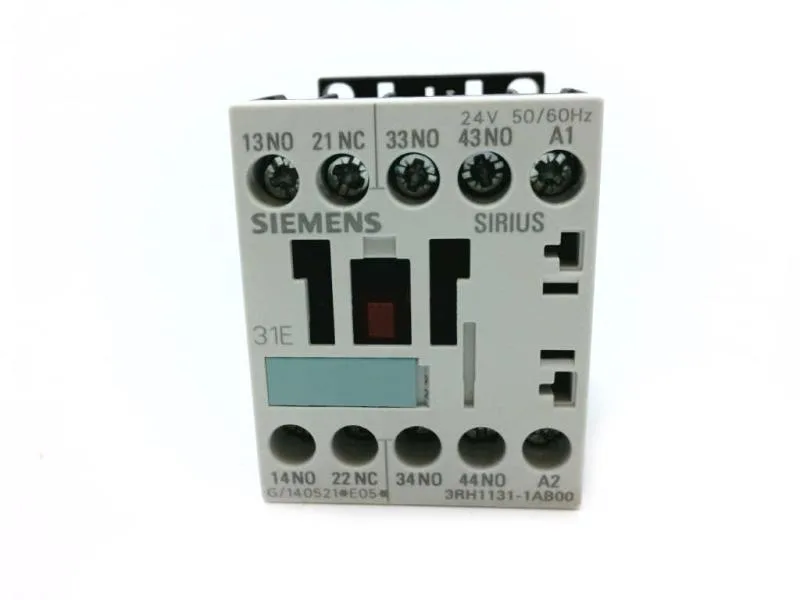
It carries three instantaneous normally-open contacts, each rated 10 A at 24 V, with a contact reliability of one incorrect switching operation per 100 million operations at 17 V, 1 mA. That reliability figure tells you it's built for dry-circuit logic-level switching, not just power contacts.
The 3 NO contacts are instantaneous — no make-before-break or delayed action here. The rated currents drop off with voltage: 10 A at 24 V, 6 A at 230 V, 3 A at 400 V, and 1 A at 690 V. At 110 V it's 1 A, at 220 V it's 0.27 A. These are the thermal current ratings for the auxiliary contacts; the actual switching capacity depends on the load type (AC-15 for solenoid loads, DC-13 for electromagnets). For a control transformer or a PLC digital output, the 24 V 10 A rating is generous; for a 690 V pilot lamp circuit, you're limited to 1 A. The contactor accepts solid conductors: 2x 0.5 to 1.5 mm², 2x 0.75 to 2.5 mm², and 2x 4 mm². That covers standard control wiring up to 4 mm². The degree of pollution is 3, meaning it's rated for conductive pollution in an industrial panel environment.