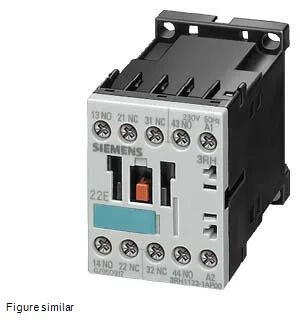
That AC-12 rating means it's specified for resistive loads at line voltage — the contactor handles the steady-state current without the inrush a motor or solenoid would draw. The 6 kV surge voltage resistance gives it a solid margin for industrial panel environments where switching transients are common.
The footprint is 45 mm wide by 57.5 mm tall by 72 mm deep — a standard S00 envelope that fits alongside contactors in the same frame size. That matters when you're fitting this into a crowded gland plate area or a swing-frame panel where the rail isn't perfectly vertical. Terminals accept solid conductors: 2x 0.5–1.5 mm², 2x 0.75–2.5 mm², or 2x 4 mm². For AWG, that's 2x 20–16, 2x 18–14, or 1x 12. The IP20 front protection means it's touch-safe on the front face once installed in a panel — standard for control cabinets where the door provides the environmental seal.
The three instantaneous contacts are rated across a range of voltages. At 24 V the contact carries 10 A; at 230 V it's 6 A; at 400 V it's 3 A; at 690 V it's 1 A. The 60 Hz rated voltage is 480 V. These are the make-and-break ratings for the contact set — use the AC-12 10 A figure as the headline resistive load limit, and derate per the voltage curve for your specific line voltage.
Shock resistance is 10g for 5 ms and 5g for 10 ms. Mechanical endurance for the contactor is 30 million operations typical.