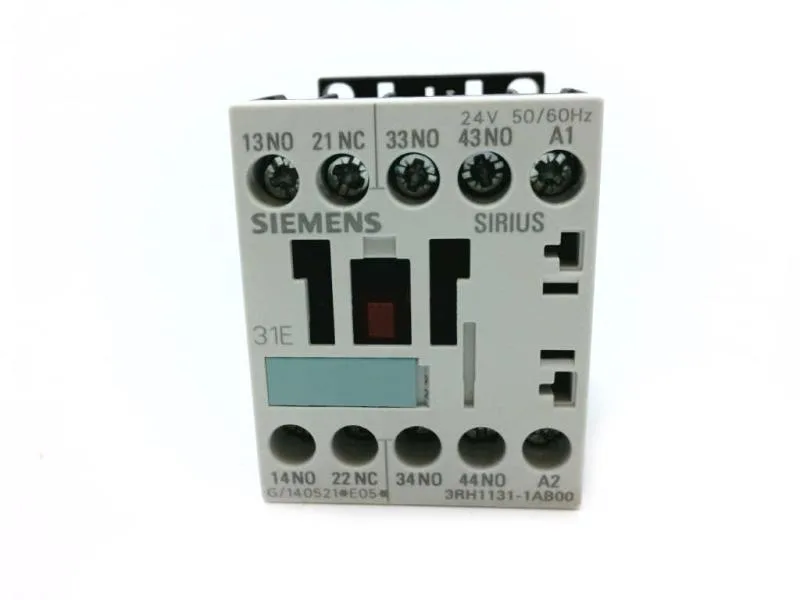
The Siemens 3RH1131-1BC40 is a SIRIUS auxiliary contactor with three normally-open (3 NO) instantaneous contacts, sized in the S00 frame. It is designed for control-circuit switching — signalling, interlocking, and logic functions inside a motor control centre or panel — not for direct motor loads. The 45 mm width and screw-and-snap-on mounting let it land on a DIN rail alongside a SIRIUS contactor or as a standalone block.
The contact ratings are given by operating voltage because the switching capacity of a control-circuit contact depends on the voltage it interrupts. At 24 V the contacts carry 10 A; at 230 V they carry 6 A; at 400 V they carry 3 A; and at 690 V they carry 1 A. These are the thermal current ratings (Ith) for the respective AC voltages — the actual make/break capacity in a given duty class (AC-15 for solenoid loads, AC-14 for resistive) will be lower. For a 24 VDC control loop the coil holding power is 3.2 W, so the 10 A rating leaves generous headroom for multiple pilot devices.
Wire sizes accepted: two conductors of 0.5–1.5 mm², two of 0.75–2.5 mm², or a single 4 mm² — spring-cage or screw terminals depending on variant (this order code uses screw terminals).
Shock resistance rated at 10g / 5 ms and 5g / 10 ms. Surge voltage resistance 6 kV. RoHS compliance date 01.07.2006 — the part meets the original RoHS directive.