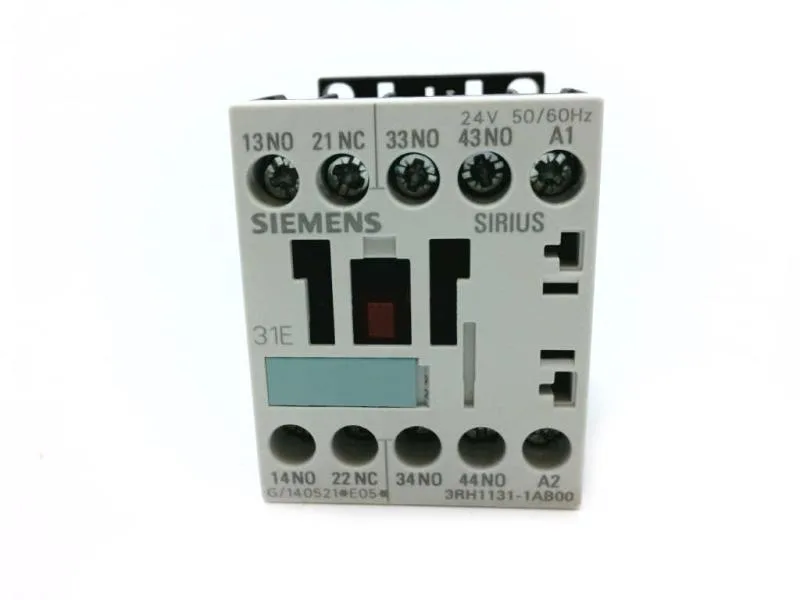
The 52 V DC coil draws 3.2 W on pickup and hold, so the control transformer and rectifier can be sized for that continuous load. That matters when you're squeezing it into a crowded gland-plate area or a swing-frame subpanel.
Switching capacity by voltage — what it actually handles
The contact ratings are given at specific voltages, not a single blanket current. At 24 V rated value it switches 10 A; at 110 V rated value it drops to 1 A; at 230 V rated value it handles 6 A; at 400 V rated value it's 3 A; at 500 V rated value 2 A; at 690 V rated value 1 A. The 220 V rated value figure of 0.27 A is notably lower than the 230 V figure — that's the DC switching curve for that coil voltage band, not a typo. For a 24 VDC pilot circuit, the 10 A rating gives comfortable headroom for a bank of solenoid valves or indicator lamps.
Wiring and integration details
The screw terminals accept solid conductors: 2x (0.5 to 1.5 mm²), 2x (0.75 to 2.5 mm²), or 2x 4 mm². AWG equivalents are 2x (20 to 16), 2x (18 to 14), or 1x 12. That covers most control-circuit wiring from signal-level through motor-circuit interposing. The 72 mm depth, 45 mm width, and 57.5 mm height keep it within the S00 footprint — fits alongside contactors and relays on the same DIN rail without overhang. That's the dry-circuit performance — important when switching PLC inputs or low-energy signals where oxide films on silver contacts can cause intermittent failures.
Environmental and electrical robustness
Shock resistance is 10g at 5 ms and 5g at 10 ms. Pollution degree 3.