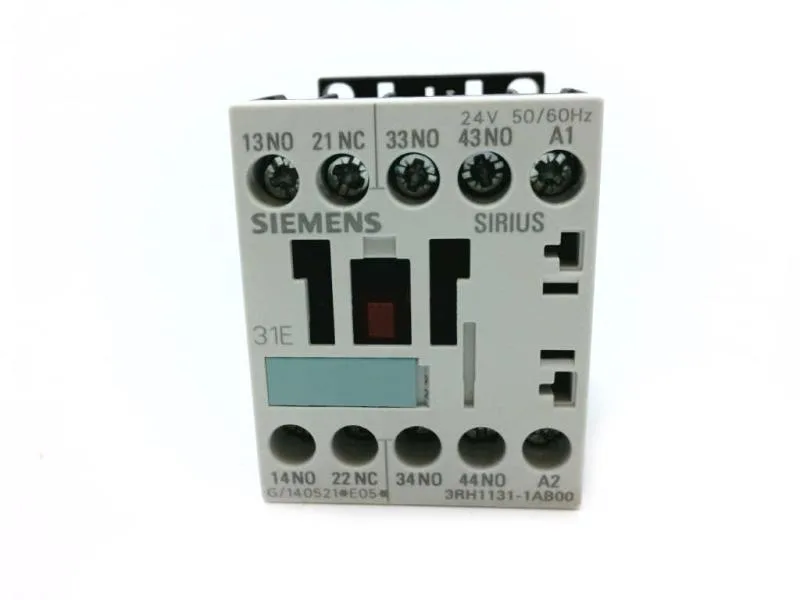
The Siemens 3RH1131-1HB40-ZW97 is a SIRIUS coupling relay designed for switching auxiliary circuits in control panels. It's a Size S00 device, meaning it fits the compact footprint of smaller contactors and relays in the SIRIUS modular system. The 24 VDC coil draws 2.3 W on both closing and holding, so the power supply budget is flat — no inrush spike to design around. Rated at 10 A for AC-12 duty (resistive loads in control circuits), it handles the typical auxiliary load of indicator lamps, contactor coils, and PLC inputs.
The 45 mm width, 57.5 mm height, and 72 mm depth keep it within the S00 envelope, so it slots next to a 3RT2 contactor without crowding. That matters when you're laying out a dense panel and need to angle the relay for wire access. Terminals accept solid conductors: 2x 0.5 to 1.5 mm², 2x 0.75 to 2.5 mm², or 2x 4 mm². IP20 on the front protects against finger contact, standard for enclosed gear.
The AC-12 rating of 10 A at 24 V is the headline number for auxiliary switching, but the relay also carries rated values across a range of voltages: 10 A at 24 V, 6 A at 230 V, 3 A at 400 V, 2 A at 500 V, and 1 A at 690 V. That's the thermal current rating derating with voltage — useful if you're switching a control transformer primary or a 400 V indicator circuit. The 6 kV surge voltage resistance gives it margin against switching transients on the line side. The 30 million typical mechanical cycles mean it outlasts most contactors it's paired with in auxiliary duty.