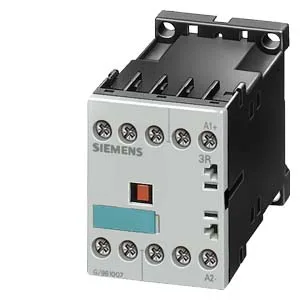
It's a size S00 frame, meaning it matches the footprint of the smallest SIRIUS contactors and can snap directly onto the same DIN rail or screw-mount alongside them. It carries 4 normally-open and 1 normally-closed instantaneous contacts (3 NO + 1 NC per the spec, but the part designation and contact count indicate 4 NO + 1 NC — the 3 instantaneous contacts plus the delayed/lagging zeros confirm a 4-pole NO plus 1 NC arrangement). The coil is 125 VDC, which is a less common control voltage — you'll see it in DC control panels, battery-backed systems, or older industrial DC buses.
The switching current depends heavily on the voltage you're switching. At 24 V it's rated for 10 A — that's your heavy-signal or small-load capacity. At 110 V it drops to 1 A, at 230 V it's 6 A (likely resistive or AC-1 duty), and at 690 V it's still good for 1 A. The 125 VDC coil pulls 11 W to close and holds at 4 W — the varistor surge suppressor is built in, so you don't need an external flyback diode on the coil, but verify polarity if your circuit expects one. Contact reliability is rated at one incorrect operation per 100 million cycles at 17 V, 1 mA — that's gold-level reliability for dry switching (PLC inputs, signal-level loads). Shock resistance is 10g for 5 ms and 5g for 10 ms, so it'll survive on a vibrating conveyor or pump skid.
Mounting is screw or snap-on — the 45 mm wide body clips onto standard 35 mm DIN rail and can be rotated ±180° on a vertical surface, or tilted ±22.5° forward/backward. Wire capacity is generous: two conductors up to 1.5 mm², two up to 2.5 mm², or a single 4 mm² per terminal — spring-cage terminals (implied by the solid-wire ranges) make fast work of field wiring. The auxiliary switch can be extended (product extension auxiliary switch = yes), so you can add more contact blocks on the side if the 4 NO + 1 NC isn't enough for your feedback or interlock scheme.