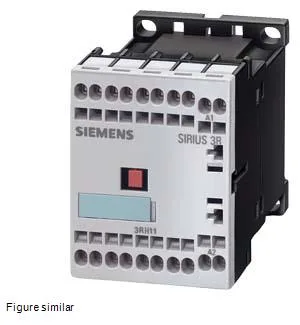
Its 42 V DC coil draws 3.2 W during both pick-up and hold, so the coil-supply transformer or PLC output must be sized for that continuous load. Three normally-open instantaneous contacts handle the switching; there are no delayed, leading, lagging, or make-before-break contacts on this variant.
Switching capacity by voltage — what the ratings mean
The contact ratings are given at specific operating voltages, not as a single blanket current. At 24 V it carries 10 A; at 110 V it drops to 1 A; at 230 V it handles 6 A; at 400 V it is rated 3 A; at 500 V it is 2 A; and at 690 V it is 1 A. The 230 V and 400 V figures are the ones most often checked in European panel designs — 6 A at 230 V covers most pilot-duty and signal-lamp loads, while 3 A at 400 V is enough for small contactor coils or indicator circuits in a 400 V line. The 690 V rating (1 A) confirms it can be used in 690 V control circuits, but the current is low enough that you should verify the inrush of the downstream device.
Mounting is by screw or snap-on onto a DIN rail. The screw terminals accept 2x (0.25 … 2.5 mm²) solid or 2x (24 … 14 AWG) stranded — strip length and ferrule size should follow the standard 8 mm practice for this terminal class.
Shock resistance is 10g / 5 ms and 5g / 10 ms — adequate for most industrial machinery but not for high-g mobile or marine applications without additional damping.