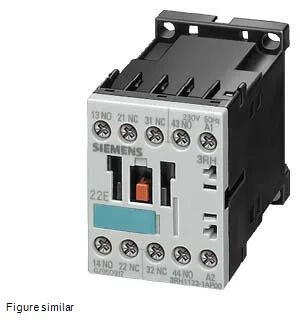
The 4 NO contacts are all instantaneous — no leading, lagging, or make-before-break timing — which means this is a straight signal repeater, not a sequenced switching block. That keeps the wiring simple: land your control wires on the spring-cage terminals (accepts 0.5 to 4 mm² solid or 20–12 AWG) and it mirrors the main contactor's state.
Size S00 is the smallest SIRIUS frame — 45 mm wide, 57.5 mm tall, 72 mm deep — so it tucks into tight DIN-rail rows alongside the matching 3RT2 contactor. The screw terminals handle two conductors per clamp — 2x 0.5–1.5 mm², 2x 0.75–2.5 mm², or 2x 4 mm² — which is handy when you're daisy-chaining common wires across multiple auxiliary blocks. AWG equivalents are 2x 20–16, 2x 18–14, or 1x 12.
Out here in the grease, the thing that keeps a contactor alive is how it handles the environment. The 3RH1140-1AF10 operates from -25 to +60 °C and takes a 10g shock at 5 ms or 5g at 10 ms — that's enough for most conveyor lines and pump skids, though I'd still mount it away from the hammer end of a vibrating motor. Contact reliability is rated at one incorrect switching operation per 100 million cycles at 17 V, 1 mA — that's the dry-circuit spec for low-energy signals. If you're switching PLC-level 24 VDC signals, it'll hold up for decades.
RoHS compliance date is listed as July 1, 2006, which means it meets the EU substance restrictions. No REACH or UL marking appears in the spec sheet, but the SIRIUS family typically carries CE and cULus — verify the specific approval on the nameplate for your jurisdiction.