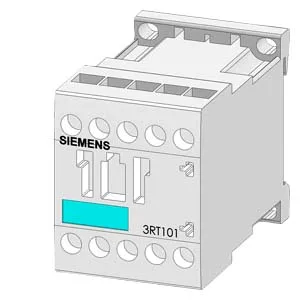
Part identity and function
The Siemens 3RH1140-1AP00-0TK0-ZX95 is a SIRIUS auxiliary contactor in frame size S00, designed for switching control circuits and signaling loads in industrial control panels. It carries four normally open instantaneous contacts (4 NO) with no leading, lagging, delayed, or make-before-break switching — a straightforward 4-pole make contact block for interlocking, feedback, or PLC input isolation.
Contact ratings and switching capability
Rated for 10 A at 24 V, 6 A at 230 V AC, and 3 A at 400 V AC — these are the thermal continuous currents the contacts can carry in their respective voltage classes. At 110 V the rating drops to 1 A, at 220 V to 0.27 A, at 500 V to 2 A, and at 690 V to 1 A, reflecting the arc-quenching limits of the contact gap at higher potentials. Contact reliability is specified as one incorrect switching operation per 100 million operations at 17 V, 1 mA — a dry-circuit rating that matters when switching low-energy signals from sensors or PLC outputs where oxide films might otherwise block conduction. The contacts are rated for a surge voltage resistance of 6 kV.
Mounting and integration
Mounts via screw fixing or snaps onto a DIN rail; the 45 mm width matches the S00 footprint. The mounting position allows ±180° rotation on a vertical surface and ±22.5° tilt forward/backward — useful when orienting the contactor to align with wiring ducts or terminal blocks in a crowded panel. IP20 protection on the front means finger-safe against accidental contact, but the contactor is not sealed against dust ingress or washdown — it belongs inside a cabinet, not on an exposed machine frame.
Environmental and mechanical endurance
Operating temperature range is -25 to +60 °C; storage and transport tolerate -55 to +80 °C — the wider storage band covers warehouse and shipping extremes without damage. Shock resistance is rated at 10g for 5 ms and 5g for 10 ms, sufficient for installation on vibrating machinery or in panels mounted on pump skids. Pollution degree 3 means the contactor is designed for environments with conductive pollution or dry non-conductive pollution that could become conductive due to condensation — typical of industrial control rooms without climate control. Mechanical endurance is 30 million operating cycles typical, which for an auxiliary contactor used in signal switching translates to years of service in most production lines.
Wire termination
Terminals accept solid conductors: two wires of 0.5–1.5 mm², two of 0.75–2.5 mm², or two of 4 mm² — the dual-wire capacity simplifies daisy-chaining control voltage or commoning multiple contacts without extra terminal blocks.
Lifecycle and compliance
RoHS compliance is declared with a substance prohibition date of July 1, 2006, covering the original EU RoHS directive.
