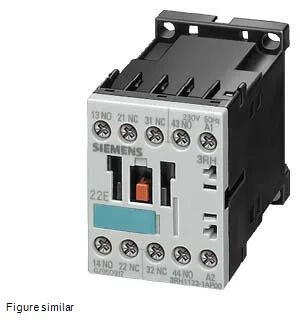
It's the contact-multiplier block you snap onto a DIN rail or screw-mount inside a control panel, rated for AC-12 duty at 10 A, so it handles resistive loads on contactor coils, PLC outputs, or signal circuits without derating.
The AC-12 operational current of 10 A is the headline number — that's the resistive-load rating at 24 V, where it can switch a full 10 A. At 230 V the rating drops to 6 A, at 400 V to 3 A, and at 690 V to 1 A. These are the thermal current limits for the contact set; if you're switching motor coils or solenoids (AC-15 duty), you'll need to derate further. The 4 NO contacts are all instantaneous, so there's no built-in timing — if the circuit needs a delayed or overlapping contact, this isn't the variant. Screw terminals accept 2x 0.5 to 1.5 mm², 2x 0.75 to 2.5 mm², or 2x 4 mm² solid, plus AWG equivalents. That's enough for most control-circuit wiring; the double-wire capacity is handy for daisy-chaining commons.
That's useful when you're packing a dense panel and need to orient the contactor for wire routing. Shock resistance is 10g at 5 ms and 5g at 10 ms — fine for most industrial cabinets, but check if the application has repetitive high-G impacts.