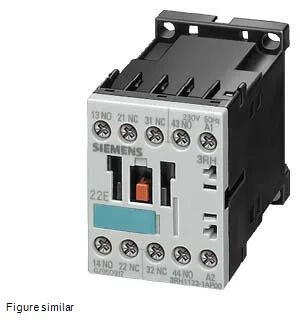
Its 42 V DC coil pulls in at 0.8x rated voltage and holds at 3.2 W, so the control transformer or PLC output driving it needs to source that inrush and seal current. The four normally-open instantaneous contacts are rated for switching at various voltages: 10 A at 24 V, 1 A at 110 V, 0.27 A at 220 V, 6 A at 230 V, 3 A at 400 V, 2 A at 500 V, and 1 A at 690 V — meaning the same contact set handles both 24 VDC pilot-duty and 400 VAC motor-circuit interlocking, but the ampacity drops fast as voltage climbs.
At 45 mm wide, 57.5 mm tall, and 72 mm deep, it fits a standard 45 mm slot in a control panel layout.
Terminals accept solid or stranded copper: 2x (0.5...1.5 mm²), 2x (0.75...2.5 mm²), or 2x 4 mm² per clamp, with AWG equivalents of 2x (20...16), 2x (18...14), or 1x 12. That's enough for daisy-chaining control wiring through the same terminal without a separate junction block.
Shock resistance is 10g for 5 ms and 5g for 10 ms, so it survives shipping drops and moderate machine vibration. Contact reliability is rated at one incorrect switching operation per 100 million cycles at 17 V, 1 mA — that's dry-circuit capability for PLC-level signals, not just power contacts. The mechanical endurance is 30 million operating cycles typical.