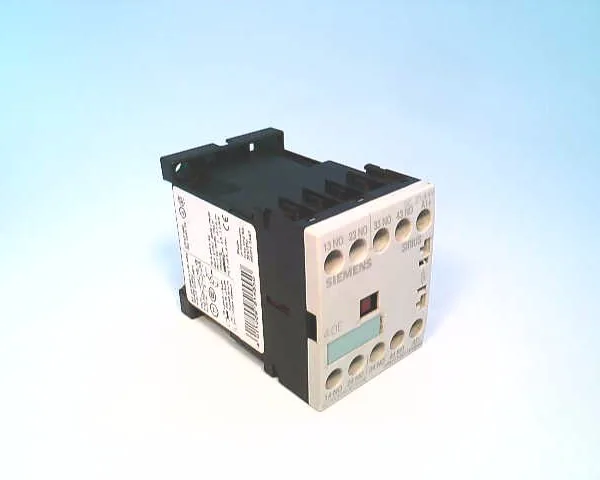
It's part of the SIRIUS family, built on the S00 frame size, which is the compact footprint for smaller control loads. It carries 4 normally-open (NO) instantaneous contacts — no delayed, lagging, or make-before-break options on this variant. That means all four close the instant the coil picks up, and all four open the instant it drops out. Useful when you need multiple independent control signals to switch simultaneously. The coil is rated 24 VDC, with a pick-up threshold of 85% of rated voltage (so 20.4 VDC minimum to pull in) and a dropout around 15% (roughly 3.6 VDC). Holding power is a steady 1.4 W DC — no AC hum, no inrush spike to manage.
The contact ratings are given per voltage for AC-12 duty (resistive loads at rated voltage): 10 A at 24 V, 6 A at 230 V, 3 A at 400 V, 2 A at 500 V, and 1 A at 690 V. For inductive or motor loads, derate accordingly — this is an auxiliary contactor, not a power contactor. The 10 A maximum at AC-12 tells you it's sized for control circuits, not main motor switching. Electrical life will be shorter depending on switched current and load type, but the mechanical figure gives you a sense of the design margin for high-cycle applications like conveyor interlocks or valve position feedback. Surge suppression is built in — a varistor across the coil. That saves you from adding an external snubber or diode on the DC coil, which is one less thing to wire and one less failure point. The varistor clips voltage spikes when the coil de-energizes, protecting nearby PLC outputs or relay contacts.
Mounting and environment — what fits in the van
The S00 frame is 45 mm wide, 57.5 mm tall, and 72 mm deep, so it tucks into tight enclosures alongside the main contactor. That covers most panel layouts without worrying about orientation derating. IP20 on the front — finger-safe but not sealed. No washdown rating here; it belongs in a closed cabinet, not on a food line or outdoors. Shock resistance is 10g for 5 ms and 5g for 10 ms — fine for most industrial panels on machine frames, but not rated for continuous vibration from a large unbalanced motor or crusher. If the panel is on a vibrating platform, you'll want to check the mounting position and add vibration dampers.
Terminals accept solid or stranded wire: 2x 0.5 to 1.5 mm², 2x 0.75 to 2.5 mm², or 2x 4 mm². That covers common control wiring sizes — 1.5 mm² for most signal runs, 2.5 mm² for longer distances or daisy-chained commons. The dual-entry per terminal lets you loop through without a separate terminal block. Clearance on the sides is 0 mm — meaning you can butt it against adjacent devices on the DIN rail without derating. That's a space-saver in dense panels. Above that, air density drops and clearance/creepage distances may need to be increased. For most plant-floor installations below 2,000 m, this is a non-issue.