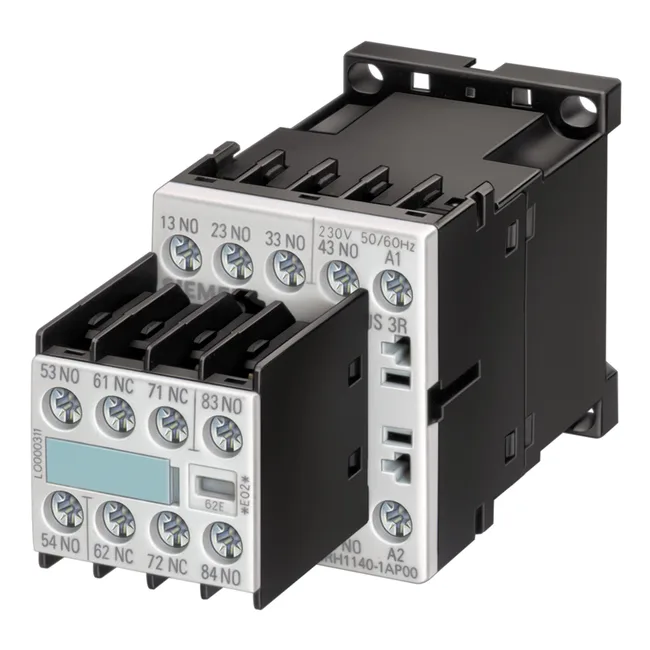
The Siemens 3RH1140-2JB40 is a SIRIUS coupling relay designed to switch auxiliary circuits in control panels — think PLC output isolation, interposing between a controller and a motor contactor coil, or extending contact density in a safety circuit. The 24 VDC coil draws a constant 2.3 W whether picking or holding, so there's no inrush spike to stress a PLC output card.
This relay carries four instantaneous normally-open contacts (no delayed, lagging, or make-before-break variants). For higher-voltage auxiliary circuits, the current drops off: 6 A at 230 V, 3 A at 400 V, 2 A at 500 V, and 1 A at 690 V. That derating curve tells you this part is at home in 24 VDC or 230 VAC control schemes, not for switching 690 V motor loads directly.
The coil includes a built-in diode surge suppressor, so you don't need an external flyback diode across the coil terminals — one less part to install and one less thing to verify polarity on.
Mechanical endurance
Rated at 30,000,000 mechanical operating cycles — that's the life of the mechanism before wear, not the electrical life under load. For a relay that mostly sits energized in a control cabinet, that number is effectively infinite for the panel's service life. Shock resistance is 10g for 5 ms and 5g for 10 ms, which covers most industrial vibration from contactors and drives in the same enclosure.