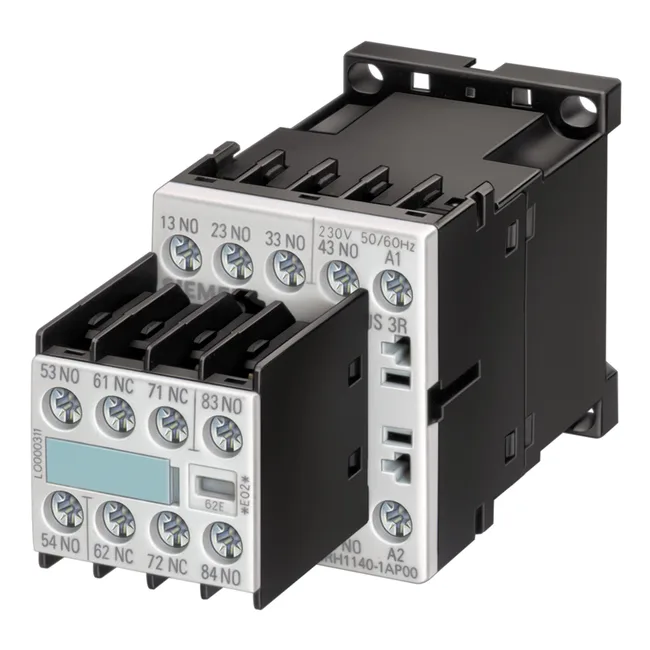
The Siemens 3RH1140-2KJ80 is a SIRIUS coupling relay — a contactor-style auxiliary relay designed to switch control circuits in motor starter and PLC output panels. It carries 4 normally-open instantaneous contacts and a 72 V DC coil with an integrated varistor surge suppressor. The relay snaps onto a DIN rail or screws directly to a mounting plate, and its size S00 footprint (45 mm wide, 60 mm tall, 73 mm deep) fits standard panel layouts alongside S00 contactors. The coil draws 2.3 W on closing and holds at 2.3 W DC — no inrush spike beyond the steady-state power. That matters for PLC output cards or DC supplies with limited per-channel current; the relay won't pull more than its rated holding power once sealed.
Contact ratings — the so-what
The contacts are rated 10 A at 24 V, 6 A at 230 V, 3 A at 400 V, 2 A at 500 V, and 1 A at 690 V. These are thermal current ratings for AC loads — the relay switches auxiliary circuits, not motor power. At 110 V the rating drops to 1 A, and at 220 V to 0.27 A, so if you're switching a 110 V control transformer secondary, verify the load stays under 1 A. The 4 NO contacts are all independent; there are no NC or changeover contacts on this variant. For gold-flashed or low-level signal switching, this relay is rated for it.
That gives flexibility in tight enclosures — you can orient the relay to align with wireways. Shock resistance is 10g / 5 ms and 5g / 10 ms — adequate for panel-mounted equipment in machinery with moderate vibration.