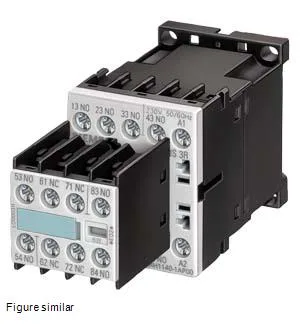
Its six normally-open (NO) instantaneous contacts handle the signal-level and pilot-duty loads that sequence a panel: PLC outputs, relay coils, contactor coils, indicator lamps. The 6 kV surge voltage resistance means the contacts are rated to withstand transient overvoltages common in industrial control circuits without welding or degrading — a practical spec for panels fed from long cable runs or switching inductive loads.
At 45 mm wide and 57.5 mm high, with a 111 mm depth, this contactor fits the standard DIN-rail grid. The screw and snap-on mounting lets a panel builder clip it onto the rail and secure it with a single screw — no bracket kit needed. That matters when you're routing wire bundles around a crowded gland plate or fitting the contactor into a shallow sub-panel.
Contact ratings and wiring
Each contact is rated for a specific load at a given voltage — not a single blanket current. At 24 V the contacts carry 10 A; at 230 V AC they carry 6 A; at 400 V AC, 3 A; and at 690 V AC, 1 A. The 50 Hz rated value of 42 V and 60 Hz rated value of 42 V define the minimum operating voltage for reliable switching. The solid wire capacity accepts 2x 0.5...1.5 mm², 2x 0.75...2.5 mm², or 2x 4 mm² — enough for daisy-chaining multiple contacts in a control circuit without a separate terminal block.