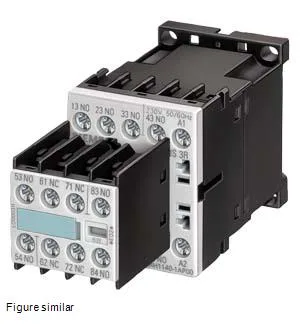
It's the part you reach for when you need to extend the contact count on a main contactor or interlock a sequence without adding a full power contactor. Rated at 10 A at 24 V and with a surge voltage resistance of 6 kV, this auxiliary contactor handles the typical control voltages in a 24 VDC or 24 VAC cabinet without derating worries. At higher voltages the rating drops (1 A at 110 V, 0.27 A at 220 V), which is normal for DC switching where arc extinction is harder, so if you're running a 110 VDC control circuit, plan for the lower current.
Depth at 111 mm is the dimension that sticks out from the rail — check your enclosure depth if you're back-paneling with a gland plate close behind. Wiring accepts solid conductors: two terminals each for 0.5–1.5 mm², two for 0.75–2.5 mm², and two for 4 mm², which covers most control wiring from signal pairs to heavier power-feed wires.
Contact reliability and switching life
That's the low-energy switching guarantee — important if this contactor is used to read dry contacts or low-voltage signals where oxidation or film on the contacts can cause intermittent failures.