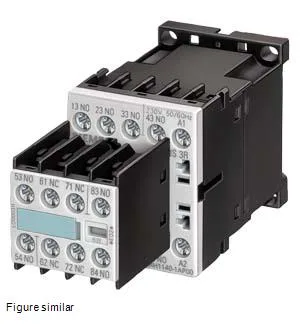
Auxiliary contactor for control-circuit switching
It is designed for switching control circuits, signal interlocking, and feedback loops inside motor starter assemblies or PLC output isolation — not for direct motor loads. The screw and snap-on mounting fits standard DIN rails, and the 45 mm width leaves room for adjacent devices in a crowded panel.
The contact ratings are voltage-dependent, which is typical for DC switching where arc extinction is harder at higher voltages. At 24 V the contacts carry 10 A; at 110 V they carry 1 A; at 220 V they drop to 0.27 A. For AC loads the ratings are higher: 6 A at 230 V, 3 A at 400 V, 2 A at 500 V, and 1 A at 690 V. The 6 kV rated surge voltage resistance (impulse withstand) means the contactor can handle transient spikes common in industrial control panels without flashover — important when sharing a cabinet with contactors or drives.
Coil and environmental limits
The DC coil draws 3.2 W during both closing and holding — no power drop after pickup, so the coil stays warm. The pickup threshold is 0.9 x rated voltage (99 V minimum), and the dropout is 0.1 x rated voltage (11 V). Shock resistance is 10g / 5 ms and 5g / 10 ms, adequate for most machine-mounted applications.
Wiring and mounting flexibility
The screw terminals accept solid or ferruled stranded conductors: 2x (0.5 to 1.5 mm²), 2x (0.75 to 2.5 mm²), or 2x 4 mm² (single conductor). AWG equivalents are 2x (20 to 16), 2x (18 to 14), or 1x 12. This helps when routing wires in tight enclosures or when the contactor must sit at an angle to clear a gland plate.
RoHS compliance date is July 1, 2006 (the EU RoHS effective date), indicating the design meets the original RoHS directive.