What it is and what it does
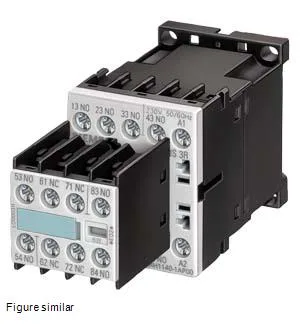
The Siemens 3RH1453-1AP00-4AA0 is a SIRIUS auxiliary contactor, size S00, designed to switch control circuits and signal loads in motor control centers and panel builds. It carries five normally open instantaneous contacts, with a rated operational current of 10 A at 24 V, tapering to 1 A at 690 V — so it handles the full range of control voltage levels you'd find in a standard 24 VDC to 690 VAC cabinet. The contactor mounts via screw or snap-on to a DIN rail, with a footprint of 90 mm wide by 57.5 mm high and 114 mm deep — a compact S00 frame that fits tightly into crowded enclosures.
Key ratings and what they mean for fit
The 5 NO instantaneous contacts (no leading, lagging, or make-before-break) are rated for AC-15 and DC-13 auxiliary loads typical of contactor coils, solenoid valves, and indicator lamps. The 10 A at 24 V rating covers most PLC output and relay coil switching; at 230 V AC it's still good for 6 A, and at 400 V AC it handles 3 A. That means it can switch a small contactor coil or a bank of pilot lights without derating concerns. Mechanical endurance is rated at 5 million switching operations typical, with contact reliability of one failure per 100 million operations at 17 V, 1 mA — so it's dependable for low-energy signal switching where oxidation on dry contacts would otherwise cause intermittents. Surge voltage resistance is 6 kV, pollution degree 3, and the IP20 front means it's protected against finger contact but not washdown — standard for enclosed panel mounting.
Where it fits in the panel
Screw and snap-on mounting on a DIN rail, with mounting position flexibility: +/-180° rotation on a vertical surface, and +/-22.5° tilt forward/backward. That gives the panel builder room to orient the contactor for wire routing or access. Terminal capacity accepts solid conductors from 0.5 mm² up to 4 mm², with two terminals per clamp for daisy-chaining. Strip length and ferrule sizing follow standard SIRIUS practice. Operating temperature range is -25 to +60 °C, storage and transport -55 to +80 °C, which covers most indoor industrial environments without special derating.
