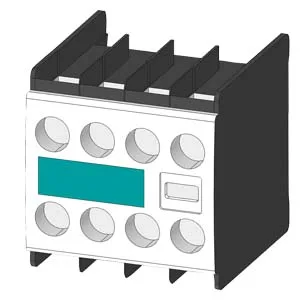
It uses screw-type terminals for the auxiliary and control circuits, accepting 2x (0.5... 1.5 mm²) or 2x (0.75... 2.5 mm²) with core-end processing, or 2x (20... 16) and 2x (18... 14) AWG. Rated for a maximum of 10 A, the contact ratings vary by voltage and duty: at 24 V it handles 6 A (10 A rated value), at 60 V it handles 2 A (4.7 A rated value), at 110 V it handles 1 A (3 A rated value), at 220 V it handles 0.3 A (1.2 A rated value), at 400 V it handles 3 A (0.5 A rated value), and at 600 V it handles 0.26 A rated value. The AC-15 rating at 690 V is 1 A. These are the switching limits for the auxiliary contacts — match your load voltage and current to the appropriate row. Mechanical service life is typical 10,000,000 switching cycles, with contact reliability rated at 1 faulty switching per 100 million operations at 17 V, 1 mA — a solid figure for low-energy signal circuits where oxide films can cause intermittent opens.
This part is a phased-out product. The official successor is the SIRIUS 3RH2 series. For new designs or BOM replacements, plan to qualify the 3RH2 equivalent for your specific contactor frame and wiring scheme.
Snap-on mounting directly onto the front of a size S00 contactor — no DIN rail required for the block itself, though the contactor typically mounts on a 35 mm rail. Dimensions are 36.5 mm wide, 37.5 mm high, and 41.5 mm deep, so it adds minimal depth to the contactor assembly. The 2 NO contacts follow EN 50005 terminal numbering.