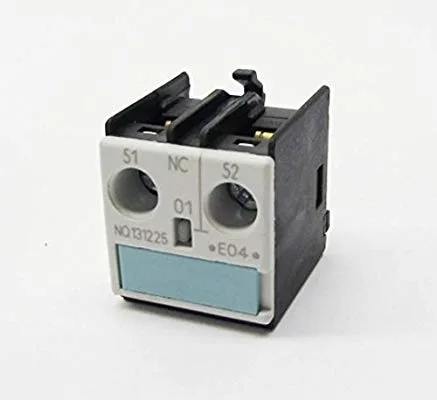
It snaps onto the front of the base device, giving you extra signaling or interlocking without additional wiring space on the rail. Rated for a maximum of 10 A, with contact reliability specified at one incorrect switching operation per 100 million cycles at 17 V and 5 mA — meaning it handles both power-level pilot duty and low-level logic signals without nuisance failures.
The 2 NO contacts are rated across multiple voltage levels: 6 A at 24 V, 6 A at 125 V, 6 A at 230 V, and 3 A at 400 V. These are the AC-15 / utilization-category figures that govern inductive pilot-duty loads like contactor coils and solenoid valves. The 0.3 A rating at 220 V and 1.2 A at 220 V (two separate entries) reflect different duty curves — the lower figure likely applies to DC switching, the higher to AC. For DC loads, the 24 V rating of 10 A and the 60 V rating of 4.7 A give you the practical break capacity. The block is IP20 on the front.
Snap-on mounting onto the contactor front, no DIN rail space consumed. Screw-type terminals accept 2x (0.5 to 1.5 mm²) or 2x (0.75 to 2.5 mm²) with core-end processing, or 2x (20 to 16) and 2x (18 to 14) AWG. The block dimensions are 36.5 mm wide, 37.5 mm high, and 41.5 mm deep — it adds minimal projection beyond the contactor face.