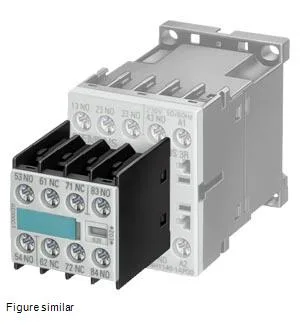
It provides 2 normally open and 2 normally closed instantaneous contacts in a single block, with screw-type terminals for the auxiliary and control circuit wiring. The block snaps onto the front of size S00 contactors — no tools needed for the mechanical install, just align and push down on the DIN-rail-mounted contactor.
The contacts are rated for a maximum continuous current of 10 A, but the real-world switching capacity depends on the voltage and load type. At 24 V DC the contacts handle 6 A; at 125 V DC it's also 6 A, but at 220 V DC that drops to 0.3 A — DC arcs are harder to extinguish, so the rating falls fast as voltage climbs. For AC loads at 230 V the contacts carry 6 A, and at 400 V they carry 3 A. These are the values that govern whether the block can switch the specific pilot device, relay coil, or indicator lamp in your circuit — the 10 A figure is the thermal limit, not the switching capability at every voltage.
Mounting and wiring — panel-builder notes
The block measures 36.5 mm wide, 37.5 mm high, and 41.5 mm deep — it adds minimal depth to the contactor face. The screw terminals accept two conductors per clamp: either 2x (0.5 to 1.5 mm²) or 2x (0.75 to 2.5 mm²) with core-end processing, or the AWG equivalents of 2x (20 to 16) and 2x (18 to 14).
Contact reliability and service life
If your circuit runs at those levels, the block is designed to handle it. Surge voltage resistance is rated at 6 kV, and the insulation voltage at pollution degree 3 is 690 V AC.