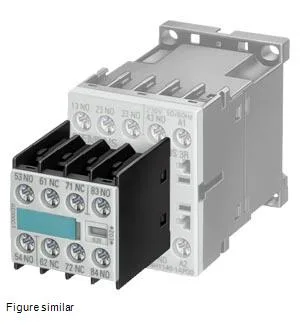
The Siemens SIRIUS 3RH1911-1GA04-ZW97 is a 4-pole auxiliary switch block with 4 normally open (NO) and 4 normally closed (NC) contacts (44 E per EN 50011), designed for use with contactor relays and power contactors in control panels. It mounts via snap-on onto a DIN rail, taking up 36.5 mm width and 41.5 mm depth, with a height of 37.5 mm — compact enough for dense panel layouts where every millimeter counts. The screw-type terminals accept 2x (0.5 to 1.5 mm²) or 2x (0.75 to 2.5 mm²) conductors with core-end processing, or 2x (20 to 16) / 2x (18 to 14) AWG for auxiliary circuits.
Rated at 10 A maximum, but the real switching capacity depends on voltage and duty. At 24 V it switches 6 A (AC-15? the spec doesn't label the duty, but these are typical auxiliary contact ratings for control circuits). At 230/250 V it handles 6 A, dropping to 3 A at 400 V and 1 A at 690 V — so for 400 V control circuits (common in European panels), derate to 3 A per contact. For DC switching: 10 A at 24 V, 4.7 A at 60 V, 3 A at 110 V, 1.2 A at 220 V, 0.5 A at 440 V, and 0.26 A at 600 V — the DC arc is harder to extinguish, so the current drops fast as voltage climbs. If you're switching a DC solenoid or valve at 110 V, plan for 3 A max per contact.
Insulation voltage is 690 V at pollution degree 3, with surge voltage resistance of 6 kV — adequate for 400/480 V panels with proper clearance.