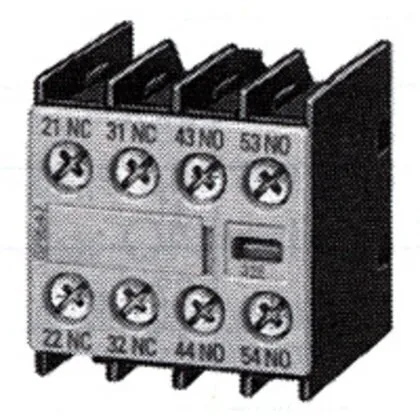
Rated for 10 A maximum, with AC-15 switching capacity derated by voltage — 6 A at 24 V, 3 A at 110 V, 1.2 A at 220 V, and 0.26 A at 600 V — so the voltage on your control circuit determines the contact's actual current capability. Snap-on mounting means it clips directly onto the contactor's front without tools, keeping the panel layout tight and the wiring within the same screw-terminal pattern.
The 10 A maximum is the thermal current (Ith); the real-world switching capacity is governed by the AC-15 duty ratings at your control voltage — at 24 V it handles 10 A, but at 440 V it drops to 0.5 A. That derating curve is what decides whether this block can handle your solenoid or contactor coil load. If you're switching PLC-level signals, this block handles them reliably. Mechanical service life is 10 million switching cycles typical — that's the mechanical endurance of the block itself, not the electrical endurance under load. Electrical life will be lower depending on the switched current and voltage. Screw-type terminals accept 2x (0.5 to 1.5 mm²) and 2x (0.75 to 2.5 mm²) with core-end processing, or 2x (20 to 16) and 2x (18 to 14) AWG. That covers standard control wiring without needing ferrules for the smaller strands. Dimensions are 36.5 mm wide, 37.5 mm tall, and 41.5 mm deep — that's the block itself, not counting the contactor it mounts on. Plan for the combined depth of the contactor plus this block when laying out the panel.