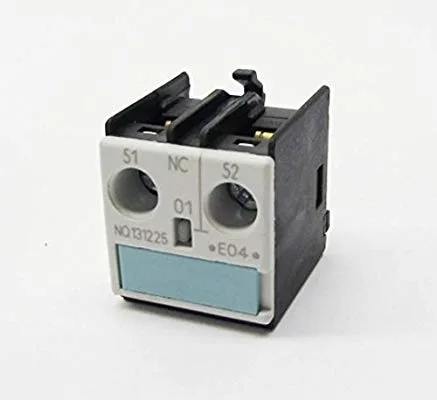
The Siemens SIRIUS 3RH1911-1HA31 is a 4-pole auxiliary switch block with a 3 NO + 1 NC contact configuration, designed for snap-on mounting onto contactor relays and power contactors in the SIRIUS family. It uses screw-type terminals for the auxiliary and control circuit connections, accepting 2x (0.5 to 1.5 mm²) or 2x (0.75 to 2.5 mm²) with core end processing, or the AWG equivalents.
This block carries a maximum thermal current of 10 A, but the real-world switching capacity depends on the circuit voltage and load type. At 24 V it switches 6 A (AC-15/DC-13 duty), while at 110 V the rating drops to 1 A. For 230 V circuits it handles 6 A, and at 400 V it is rated for 3 A. The AC-15 rating at 690 V is 1 A. These are not continuous ratings — they reflect the contact's ability to make and break inductive loads typical of contactor coils, solenoid valves, and small motor starters.
Integration and environmental limits
Snap-on mounting onto the contactor or relay — no DIN rail required, it clips directly onto the SIRIUS 3RH1 contactor family. Rated impulse withstand voltage is 6 kV, and the insulation voltage at pollution degree 3 is 690 V AC. These numbers place it firmly in standard industrial control panel duty — no special derating needed for most factory-floor environments.