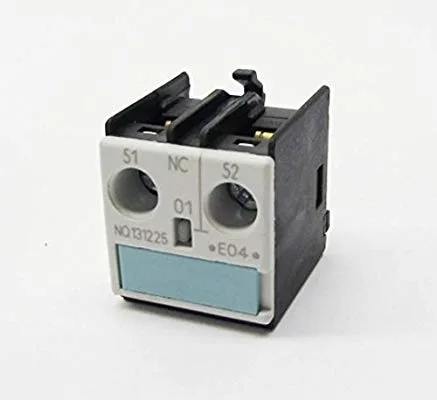
It adds one normally open (1 NO) instantaneous auxiliary contact to the base device, extending the control circuit's feedback or interlocking capability. The mirror contact feature per IEC 60947-4-1 means the NO contact mechanically mirrors the main contactor's welded status — critical for safety circuits where you need positive indication that the power contacts have opened.
Snaps onto the front of S00 contactors (e.g., 3RT1 series) without tools — no DIN rail space consumed, no extra wiring trough needed. The 36.5 mm width and 41.5 mm depth keep the assembly within the contactor's own footprint, so panel layout stays tight. Terminals accept 2x (0.5…1.5 mm²) or 2x (0.75…2.5 mm²) solid/stranded, or 2x (20…16) / 2x (18…14) AWG.
The AC-15 rating at 690 V (1 A) is the one that governs solenoid and contactor coil switching at higher voltages — the 10 A AC-12 figure applies to resistive loads only. For inductive loads like relay coils, use the AC-15 curve. The 6 kV surge voltage rating (impulse withstand) means the switch can handle transient spikes common on 400 V industrial lines without flashover. Mechanical life is 10 million cycles typical.
RoHS compliance date is listed as 07/01/2006, indicating it meets the EU RoHS directive. The mirror contact certification (IEC 60947-4-1) satisfies most machinery directive requirements for safe isolation monitoring.