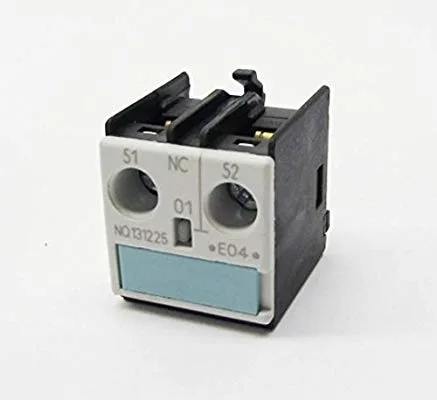
It provides one normally-open and one normally-closed contact arranged per EN 50005, with spring-loaded terminals for the auxiliary and control circuit wiring. The block snaps onto the front of size S00 contactors, adding auxiliary contacts without increasing the panel footprint.
The maximum continuous current rating is 10 A, but that's the thermal limit — the actual switching capacity depends on the voltage and load type. At 24 V it's rated for 6 A, at 125 V also 6 A, at 230 V still 6 A, but at 400 V it drops to 3 A, and at 600 V down to 0.26 A. The AC-15 rating at 690 V is 1 A, which is the inductive load rating for contactor coils and solenoid valves. For DC switching, the ratings are lower: 10 A at 24 V, 4.7 A at 60 V, 1.2 A at 220 V. That DC curve matters when you're switching DC brake coils or DC-powered indicators — the arc extinguishes differently than AC.
This part is a phased-out product. The official successor is the SIRIUS 3RH2 series. The 3RH1911-2FA11-ZW98 was sold in multi-unit packaging of 60 units. For new designs or BOM fill, the 3RH2 series is the direct replacement path.
Fastens via snap-on mounting to the contactor front. The spring-loaded terminals accept 2x (0.5 to 1.5 mm²) with ferrule or 2x (0.5 to 2.5 mm²) without core-end processing, or 2x (20 to 14 AWG). Mechanical service life is 10 million switching cycles typical, with contact reliability of 1 faulty switching per 100 million operations at 17 V, 1 mA — that's the low-level signal reliability figure you need for PLC inputs.