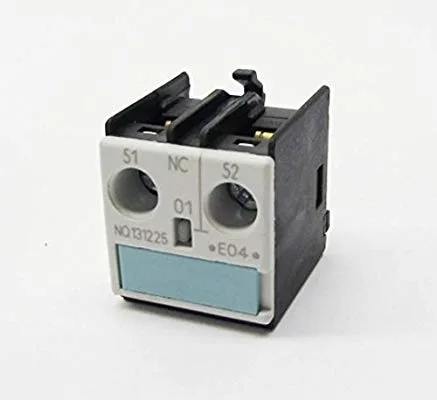
The Siemens SIRIUS 3RH1911-2GA04-ZX95 is a 4-pole auxiliary switch block with 4 normally-closed (NC) contacts arranged per EN 50011 (44E configuration). It snap-mounts onto SIRIUS contactor relays and power contactors, using spring-loaded terminals for the auxiliary and control current circuits — no screw torque to verify, just strip and push. Rated at 10 A maximum, but the real-world switching capacity depends on voltage: 10 A at 24 V, 6 A at 24 V (second rating), 6 A at 230/250 V, 3 A at 400 V. For DC-13 or low-level signal switching, the contact reliability spec is one faulty operation per 100 million cycles at 17 V, 5 mA — fine for PLC inputs and relay logic, not for dry-circuit gold-plated levels. AC-15 rating at 690 V is 1 A — this is the inductive load rating for contactor coils and solenoid valves on a 690 V line. Insulation voltage at pollution degree 3 is 690 V, surge withstand 6 kV.
This order code is a phased-out product. The manufacturer's listed successor is the SIRIUS 3RH2 series — same 4-pole auxiliary block function, same snap-on mounting footprint, but with updated terminal design and contact materials. For new designs, migrate to the 3RH2.
Width 36.5 mm, depth 46 mm, height 37.5 mm. Snap-on mounting to the contactor relay — no DIN rail required for the block itself; it clips directly onto the SIRIUS contactor or contactor relay front. Spring-loaded terminals accept 2x (0.5 to 1.5 mm²) with ferrule, or 2x (0.5 to 2.5 mm²) solid/stranded without ferrule. AWG equivalent 2x (20 to 14). Strip length 8 mm, no wire end processing needed for solid conductors.
Mechanical service life typical 10 million switching cycles. For the auxiliary contacts at low-level switching (17 V, 1 mA), contact reliability is 1 faulty operation per 100 million cycles — this is the figure that matters when the block is used in safety circuits or signal-level applications where contact resistance drift causes nuisance faults. The 10 million mechanical cycles is the limit of the spring mechanism; the electrical life will be lower depending on load current and switching frequency.