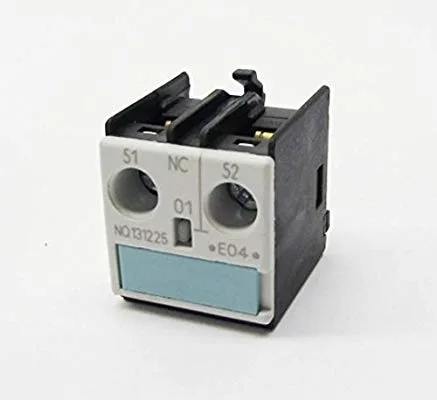
The Siemens SIRIUS 3RH1911-2GA22 is a 4-pole auxiliary switch block with 2 normally-open and 2 normally-closed instantaneous contacts, arranged per EN 50011. The contact arrangement gives you one spare NO/NC pair beyond a standard 1 NO + 1 NC auxiliary, useful for dual-feedback or interlocking circuits on a contactor relay or power contactor.
Rated current — what the numbers mean across the voltage range
The block carries a maximum thermal current of 10 A, but the switching capacity depends on the circuit voltage and load type. At 24 V DC the contacts are rated 6 A; at 60 V DC it drops to 2 A; at 110 V DC it's 1 A; at 220 V DC it's 0.3 A. For AC loads at 230 V or 250 V the rating returns to 6 A, and at 400 V AC it's 3 A. The AC-15 rating at 690 V is 1 A — that's the inductive load capability for solenoid valves or contactor coils at higher line voltages. The DC derating curve is steep because DC arcs don't self-extinguish at zero-crossing, so the contact gap and material limit the interrupting capacity. For a 24 V DC control circuit, the 6 A rating covers most PLC output and relay coil loads; for 110 V DC circuits, the 1 A limit means you're restricted to smaller solenoids or signal-level switching.
Integration notes — panel fit and wiring
The block measures 36.5 mm wide, 37.5 mm tall, and 46 mm deep — it occupies roughly the same footprint as a standard contactor relay auxiliary deck. The spring-loaded terminals accept 2 x (0.5 to 1.5 mm²) with ferrule or 2 x (0.5 to 2.5 mm²) solid/stranded without ferrule, and 2 x (20 to 14 AWG). Strip length for the spring cage is typically 8–10 mm. Surge voltage resistance is rated at 6 kV, and the insulation voltage at pollution degree 3 is 690 V AC, so it's suitable for 400 V line-to-line control circuits with proper clearance. Mechanical service life is 10 million switching cycles typical; contact reliability is 1 faulty switching per 100 million operations at 17 V, 1 mA — that's the dry-circuit performance for low-energy signals like PLC inputs.